Showing posts with label astronomy. Show all posts

Monday, 24 June 2013

The Moon...

Just a quick post tonight.  I managed to finally get my telescope outside for a short stint - though it's been quite cold of an evening (and during the day truth be told).  It's a full moon at the moment, and as anyone who follows any sort of social media will have probably read many times over, it is the time of the Super Moon.  Far from being a time when caped vigilantes are lit by the pale light reflected by the surface of the moon (sadly), it is instead the time of the moon's perigee - where it approaches Earth most closely in it's orbital cycle.

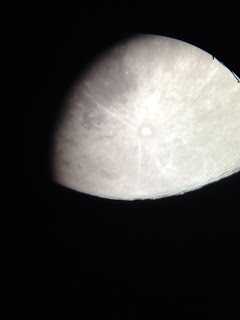
In any case, with my telescope outside I tried to take some shots of what it looked like using my phone. Given this is far from being an ideal set-up for astrophotography, it was quite difficult.  The brightness of the moon through the eyepiece was too much for my poor phone, and trying to actually pin the moon down so a photo could be taken was an annoyingly constant battle.  In the end I reduced the aperture of the telescope by using some cardboard with a hole in it - this helped to reduce the brightness.  The rest was down to my shaky hands and the fact that your garden variety iPhone is not really designed for the task of astrophotography, sadly.

In any case - here are some shots:


Cheers,
Giles.


Monday, 19 November 2012

Heavens Above...

Watching the moon slowly crawl across the disk of the sun through some eclipse glasses was a moment of duality - two competing senses, one of excitement at seeing so wonderful a spectacle, and one of stillness, a quiet sense of marvel at the machinery of the cosmos.  It inspired me to again lug my telescope outside, something I had neglected doing for most of the past winter.

The eclipse...

Winter is gone, and though the evenings are comparatively cool, they can hardly be used as an excuse.  I have four favourite things to look at in the night sky, probably because they are easy for an amateurs amateur such as myself to find.  The first is the moon; most obvious.  Next are the two largest planets in our solar system, Saturn with its rings is great to view, even with my telescope and surrounding street-light induced light pollution it appears an orange-y/yellow-y marble with the the rings clearly visible, and the most prominent moons as stars in a neat line around the planet.  Jupiter, which is visible now quite clearly is also nice.  And lastly my one-of-four favourite things is the nebula in Orion, M42, a dusty cloud in space punctuated by bright new stars.

Saturn isn’t visible during any of the hours I like to keep (it’s rising around 5.00am at the moment), but Jupiter certainly is.


Jupiter - a shot of this planet with no added equipment (just from my phone).

Viewing anything in the night sky from the backyard is always an exercise in mild frustration, the incoming flood of light from nearby street-lights can be annoying to say the least, and can also serve to wash out some of the colour from the things you’re viewing.  Nonetheless, Jupiter appears as a large bright white marble, and sometimes, on a dark night, creamy rather than white.  Several dark brown bands are also clearly visible as lines across its surface, on a dark night some of the detail of these bands can be seen, the turbulent edges, the spots.  The largest of Jupiter’s moons are also clearly visible - though these appear as stars in a rough line, changing position night to night.

Jupiter - the poor camera loses all sense of the colour and bands, but three moons are visible.


Tonight I also took some time to view the moon, since it is a crescent phase at the moment it makes for excellent viewing, the angle of the sunlight on it’s surface means the craters and mountains stand with long shadows, making the three dimensionality of the surface really stand out.


A phone's view of the moon...

I tried to take some photos using my iPhone through the eye-piece of my scope, but the results are (obviously) far poorer than what one sees with ones own eyes.

The brightness of the moon is overwhelming for the phone camera.  Nearly all the detail: lost.


It’s a cathartic experience, gazing heavenward; a good time to pause and contemplate life, the universe and everything.  The implacable march of the celestial machinery that drives the cosmos invites us to experience a sense of smallness in comparison.  A window into the fleeting nature of time and yawning enormity that surrounds us.  Far from being a depressing thing, it is humbling, a chance to to ponder the things that we as individuals invest importance in.  A vast yardstick against which my own troubles seem trifling and trivial things.  What do I think about?  The universe of course, and existence - how can one not.  But also my family: my larger family often, my friends occasionally, but most certainly my wife and my kids.


The solar system I can come at, the solar system I can wrap my mind around, but gazing into deeper space, into the turbulence of new star formation, of the death of stars, of galaxies, gazing into time itself... that I can only wonder at.  Trying to establish a mental foothold on the concept of something so... immense.  Rather than finding a foothold I end up feeling adrift, it is simply too large to fit within the confines of my small primate mind.  Adrift and in wonder.  Quietly marvelling.  

Through a smaller eyepiece...

Even through the smaller eye-piece most of the detail is lost...


Cheers,

Giles.

Saturday, 16 June 2012

Astronomy, of the amateur kind...

Earlier this week the esteemed McGurie college, here in the fine town of Shepparton, held a star gazing night.  This was an auspicious beginning, supported by the Telescopes in Schools initiative, and saw some 20 or so kids and families come along to view the cosmos.  This evening is to be the first of a series.  It was a convivial gathering, spoilt to only a small degree by poor weather conditions, some trouble with the collimation of the scope, and a near dazzling array of security lighting.  Despite these troubles we had a good night, a sound beginning to what promises to be an enjoyable and interesting program.  I was especially impressed with the energy of the organiser Robert, and of course by the telescope McGuire had at their disposal - a 12” catadioptric behemoth that required sets of castor wheels to be relocated.  Anything that requires wheels in order to be moved deserves some natural level of respect and admiration.  Yes, this giant marvel of precision engineering is ungainly and difficult to budge, but damn-it if a set of wheels won’t bring the beast to bear!


Some time out in the fresh evening, basking in the splendour of the raiment above, does wonders for one’s eagerness to dust off the scope at home and drag it out-of-doors for more.  So inspired, I pulled my more humble reflector out this evening to take in Saturn.  


While the general glow of street-lights does something to wash the colour from the view, it was rather nice to sit back and look at the orb of Saturn and its encircling rings.  It is something humbling to look at what appears to be a star through our eyes, and bring it into sharper focus with a telescope, and to find a dusty orange marble, replete with a girdling of brilliant white rings in its place.  As much as the Southern sky is splendid for its cloudy encircling arm of our galaxy, I find something especially calming and marvellous about gazing at our solar neighbours in the ecliptic.  It might not be everyone’s cup of tea, but I rather enjoyed myself.  

I tried to take some photos through the eyepiece, but I don’t really have the set-up to make it work.  The best I got was a blurry smudge that would do well on a UFO Sightings website, but wasn’t exactly what I was hoping for.  Nonetheless, a pleasant evenings viewing, and I am much looking forward to the day when my lad is old enough to come outside with his Dad and view the moon, the planets and our universe.


Cheers,
Giles.