Showing posts with label books. Show all posts

Saturday, 10 March 2018

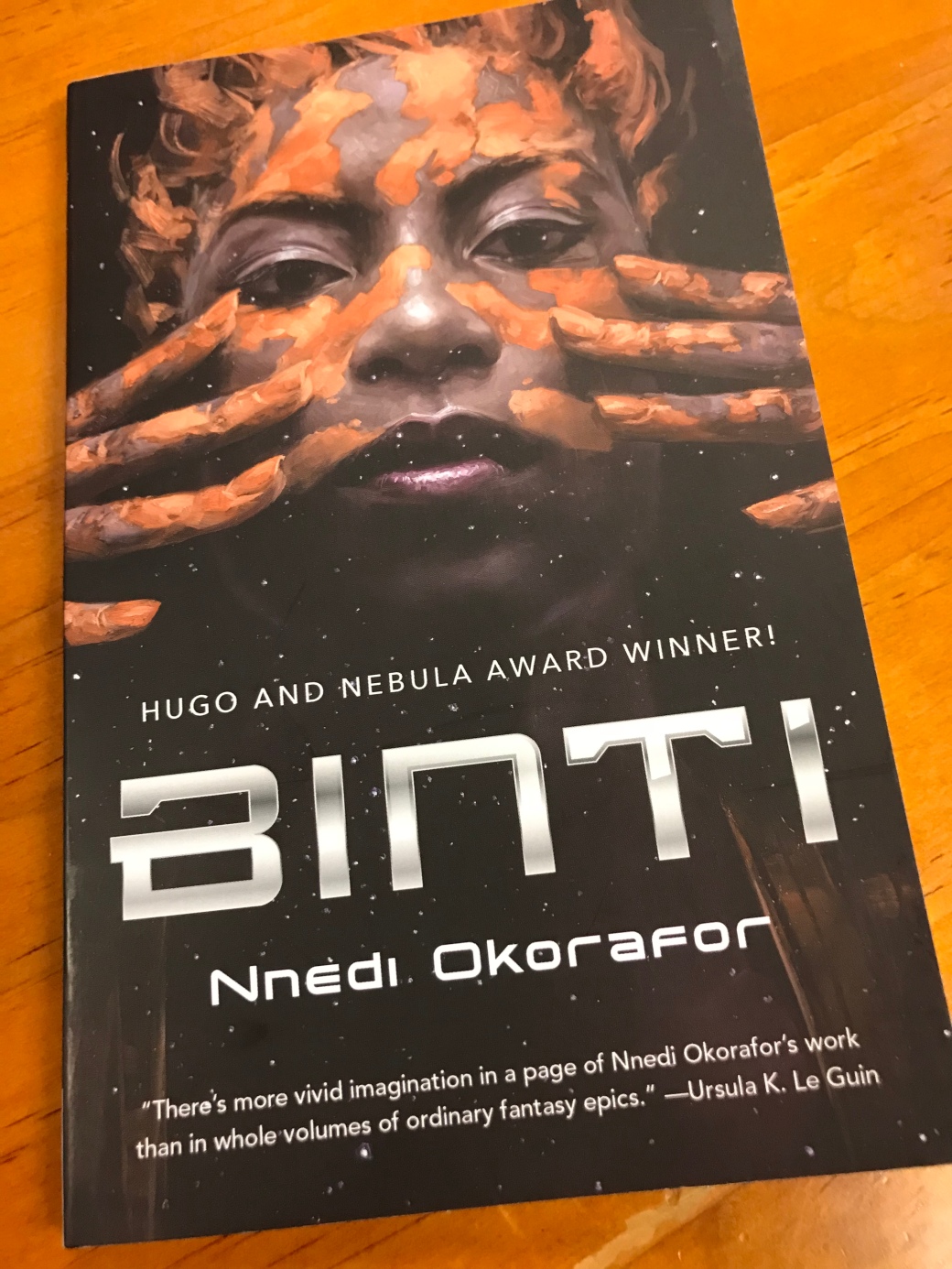
Binti, by Nnedi Okorafor

Binti, by Nnedi Okorafor, is a science fiction novella about a young Himba woman, the eponymous Binti, seeking to travel off-world to study at a prestigious university. First and foremost, this is a cracking story; imaginative and fascinating. The cultures presented, the Himba, Khoush and the alien Meduse, are wonderfully outlined and believably constructed (in the case of the fictional), or artfully related (in the case of the futuristic version of the Himba). I found myself drawn into this story, fascinated by the deep cultures presented throughout, the rich setting, and especially by the character of Binti.
Photo 10-3-18, 11 01 33 pm
Being a novella, the story itself is short and easy to read, it is also wonderfully written with every word pushing the story and relating the characters and emotion. Much time is well spent on expanding the cultures represented, often by juxtaposing expectations of those cultures against the consequences of their choices; the action/inaction of the characters. It is an engrossing read, well constructed and executed, full of feeling and emotion.
The theme I loved the most, I think (‘I think’ because I am still digesting), is the role of communication in the breakdown and formation of connections between peoples. I won’t say too much more, because I don’t like revealing too much of the story, but the capacity to communicate with reason seems a fundamental theme in the story, that coupled with a willingness to listen.
Binti is strong and vulnerable, emotional and reasonable all at the same time, and makes for a wonderful character that is easy to relate to. Her strong sense of identity and culture, and the significance of having that removed, changed or even just of leaving it, are also key themes explored intelligently in only a small number of words. There is emotion packed in here, thought and feeling that far outweighs the page count.
As seems more and more the norm for me these days, I came across Nnedi Okorafor on twitter, reading through her commentary on her journey and experiences as a writer, I was inspired to get Binti and Akata Witch, and I’m very glad I did. There is just one thing I am furious about: I didn’t order the two sequels to Binti. Now I have to wait on the post before I get to read more.

Friday, 9 March 2018

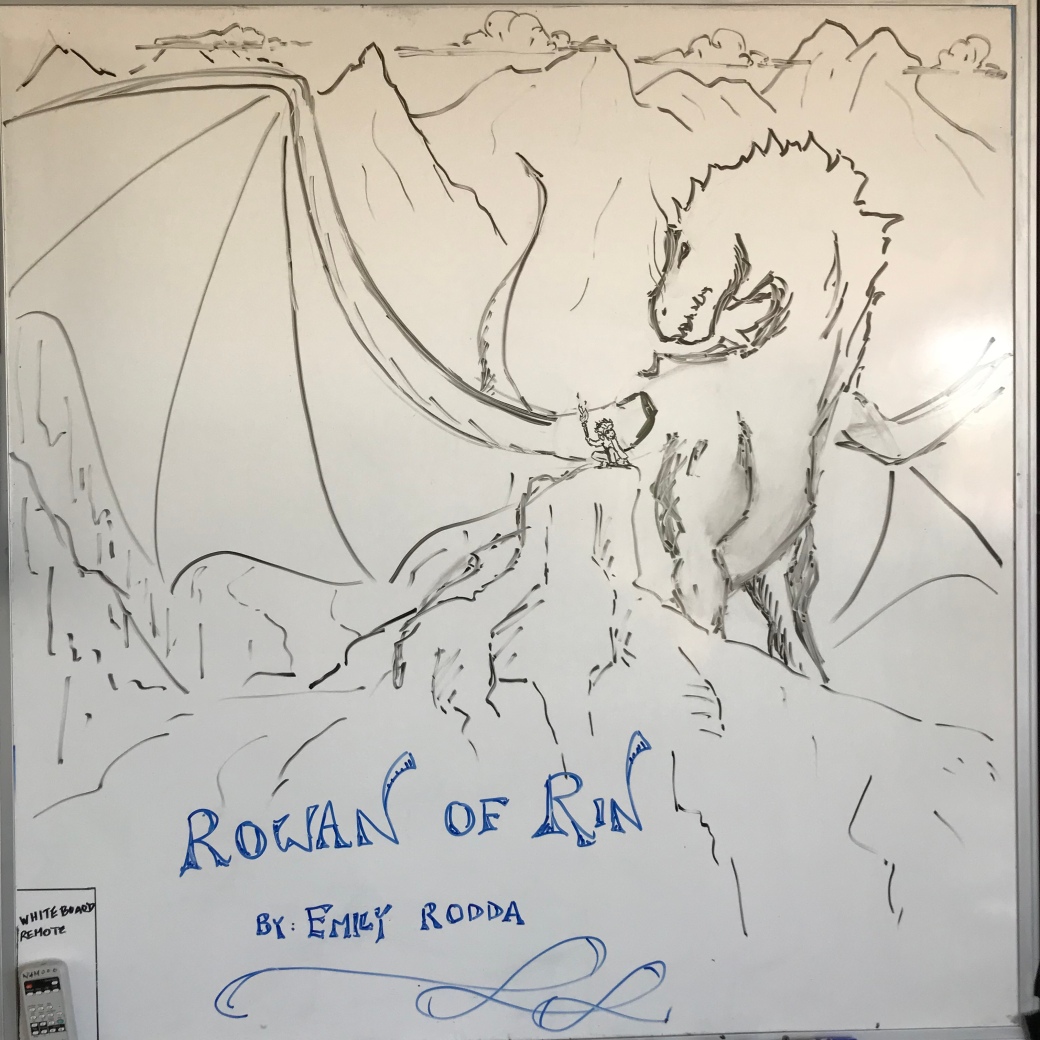
Rowan of Rin, by Emily Rodda...

Rowan of Rin is a children’s fantasy novel by author Emily Rodda (Jennifer Rowe), I just finished reading this book both to my grade 5 class, and at home to my son (grade 3). Rowan of Rin is, in many ways, a simple story, it’s plot progression, series of challenges and climax all pull from fantasy tropes, from prophesy to quest completion. It is a rags to riches tale; the story of a boy broadly rejected for his weakness and cowardice, who discovers on the quest he is forced to undertake that he has bravery and strength aplenty.
Photo 12-2-18, 1 45 49 pm
In many respects this could be described as a by-the-numbers piece of fantasy fiction: everything we expect of the genre is present. I say this not to denigrate the book, but to highlight it’s strength. Rowan of Rin is an excellent book. It is tightly plotted, cleverly evolved and well written. For those who read it carefully, or read it multiple times, the use of foreshadowing is brilliantly executed throughout. There are few books that could be described as more typically fantasy, and yet rise to achieve what Emily Rodda has managed so neatly, succinctly, and evocatively. It is a wonderful book, with no wasted verbiage, that manages to pack both adventure and emotion into a quest story heaped with character growth.
Rowan
The story itself revolves around a small village, Rin, whose water source has dried up with looming consequences. A party of adventures set forth to uncover the source of the problem, guided by the poetic prophesy of the wise-woman/witch Sheba. Rowan, a boy and the least capable of the village, is compelled to join the party, and in so doing is set upon a path of self-discovery and high adventure.
Short, with uncomplicated prose cleverly woven into a tight and emotional package, Rowan of Rin is a wonderful fantasy book. My class highly enjoyed the story, and my son is now reading the second in the series. For anyone with children, Rowan of Rin makes for a fantastic introduction to the genre. For any adults looking for quality exemplars of tight and cleverly plotted stories that use an economy of words to best effect, this is also well worth a read.


Wednesday, 7 March 2018

Artemis

Artemis is a science fiction murder mystery by Andy Weir, author of the Martian. I found The Martian to be an exceptional story. A character I liked in a do-or-die situation, using pure intellect and willpower to bully his way through every one of the multitude of problems he faces. I loved the book, and it ranks as one of my all time favourite reads. Needless to say then, when I read that Andy Weir was working on his next book I was very excited.


The story is set in the eponymous city of Artemis, humanity's first settlement beyond the fragile shores of Earth. The setting of the story is compelling. Highly detailed and lovingly crafted, Artemis is as scientifically accurate a moon-city as can be found anywhere in literature, it is, I would go so far to say, unrivaled. Like The Martian, Andy Weir shows his understanding of science and technology, which, coupled with a keen imagination, makes for a fascinating backdrop to the story.


The story itself I found to be something of a slow-burn, The Martian I read in a flurry over about a day and a bit, it hooked me from the first scene and didn't let go. Artemis was a more gradual climb. I found the main character's internal dialog to be a little abrasive at times, and the while the plotting and action was intelligent, I didn't find the reasons behind the action in the story thoroughly compelling.

All that changes as the book progresses, which is why I describe it as a slow-burn. As Jazz gets tangled in a mess far greater than she ever imagined, and the setting itself hangs in the balance, the stakes are raised to an all-time high and I was finally pulled fully into the book.

Artemis is an excellent novel, the overarching story, the raison-d'etre for the action and plotting is hidden behind a veil, off to the side of the characters and their concerns. The chief architect of this larger plot is a secondary character, and while the events in the story are important to this larger plan, the story itself, the plot of the novel, deals with a portion. The larger question, about creating an economy for Artemis moving forward and the struggles and implications that holds, are fascinating concepts. The novel though deals with a vitally connected but independent story line, which while fascinating in its own right, really shines when connected to the implications of the bigger picture.

Artemis is an intelligently written and unbelievably well conceived novel. The characters are interesting, even if a little abrasive. The writing is solid and the plot progression is good, but it is a slow-burn, in my opinion, only fully grabbing you by the throat around half-way through. Anyone who is a fan of hard science fiction would be well rewarded by reading Artemis, while I personally didn't enjoy the book as much as I loved The Martian, it is a solid offering, and I look forward to Andy Weir's next book.


Tuesday, 2 January 2018

Looking Back - Favourite Books Read in 2017

I used to read voraciously, but life, work and hobbies have all conspired to make it easy for me to devote time to other things the last few years, and I haven't been reading as much as I would like. I made a conscious decision in 2016 to try and read more books again, and while the number read in total hasn't been anywhere near what I used to get through, it has been better than the few years before I made that commitment.

This year I have a range of different books, for myself, to my kids at night, and out loud to my class. I have tried to make sure I review many of the books I have read over the course of the year, and you can find those either on Good Reads, or by clicking on the 'books' tag at the bottom of this post.

So, without wasting too many more words, what are the best books I have read in 2017?

First and foremost, the book I most often think about since finishing is Children of Time, by Adrian Tchaikovsky. You can read my review here if you're interested in more details.


Children of Time is something I keep coming back to because of the juxtaposition of the two stories that unfold. It reads like a real and thoughtful examination of the human condition, and represents both the best and worst our species is capable of. The story is different, one set of characters are alien and strange, and yet it works. The rise of civilisation charted throughout this book is measured equally against the slow disintegration of a microcosm of our own. All the characters are interesting and engaging, the story dramatic and full of highs and lows. All in all it is a book I enjoyed a lot. I thoroughly recommend looking it up, and have been very glad to note that the author, Adrian Tchaikovsky, has stated on Twitter that he is working on a sequel.


My absolute favourite book read this year has been Harry Potter and the Philosopher's Stone, by J.K. Rowling. 


I actually read this twice, once to my class and once to my son. My class enjoyed it, which was nice, but my son went from not being interested in reading this 'strange' book, to absolutely adoring it. We're currently reading Chamber of Secrets, and he is loving the Harry Potter Hogwarts Battle card game (recommended).

The moment where Harry faced down Quirell would have to be one my favourite parts of year, not just reading. My son, rapt, was sitting in his bed disbelieving. Genuinely upset at the betrayal and twist. This book changed his attitude to reading, and it was an absolute joy to be a part of that.

Harry Potter is a wonderful story, and never seems to fail in drawing readers in and capturing their imagination and their hearts - it certainly did mine, and my son was no different. It was an absolute pleasure to read this to him.


The most interesting book I read this year was Little House in the Big Woods, by Laura Ingalls Wilder.


I read this book to my class on recommendation from another teacher (thanks Tara). I was skeptical, I'll be honest. But wow. I am a convert. This book was a revelation, to myself and the kids in class both. I am not sure if I have read a book that genuinely revolted, amused, and fascinated a class more than this. Killing and butchering an animal, making cheese, playing with a corn-cob doll; all the simple every day things that consumed the lives of the Wilder family in their time in that log house was an eye-opening adventure back in time. What a wonderful book and window into another era this book is.


The most influential book I read this year was Hatchet, by Gary Paulsen.


A classic tale of survival, where a boy is pitted against nature itself in an epic quest just to survive. This book contains everything one would expect of a survival story, and is brutal in its exposition. The kids in my class were equally delighted and horrified by it. Why was it most influential? I read it out loud. The rhythm and cadence of the book is sublime. The repetition pounds the message home. The short sentences combined with long sentences and repeating phrases call to be read aloud and make the book a fascinating experience. The story is good, but the writing is fascinating. I loved it.


So, in short order there are some of my favourite books read of 2017. Not all new and shiny, some old and dusty, in fact, but all good books and thoroughly recommended. 


Friday, 17 November 2017

Terminal World, by Alastair Reynolds

Here is a book that defies classification. Science fiction melded with the fantastic, steam power and dirigibles, the visceral post apocalyptic skull boys who bear a mad-cap resemblance to the villains that hound Mad Max. All of it wound tightly around a sprawling and interesting setting, an Earth, tens, maybe hundreds of thousands of years into the future. A world built on a sense of the scientific, but sufficiently removed from us to appear, at times, magical.


The cast of characters, from the dogged former angel (yes, you read that correctly, but not 'angel' in the conventional sense) Doctor Quillon, to his rough guide, protector and sometimes hater Meroka. The genius and authorial voice of Ricasso, the determined sky-captain Curtana, are all memorable, well constructed and larger than life.

The story itself follows a twisting plot, not a simple adversary for the protagonist to defeat, but an exploration of what is fundamentally wrong with the setting itself, and the winding journey through the world that uncovers it. The setting of Terminal World is strange and wonderful, a planet overlaid with zones in each of which different technologies are possible. High zones around the mysterious city/spire Spearpoint, allow high tech, and lower zones, extending out into the world, cause this high tech to break down and stop working. We have laser fights in one section, and horse back sabre rattling in another, steam belching contraptions, and the Swarm: of sky-galleon-esque dirigibles. The explanation for all of this is fundamental to the development of the plot, so I won't go in to too many details other than to state it is engrossing. The world itself is the antagonist, the problem, and the characters' journeys explore and reveal it in stepped clues that reveal its true nature.

For all the seeming absurdity, the tour de force of imagination writ large in a setting both magical and scientific, it is a world that I found interesting and engaging. A story that I found strange and wonderful in equal measure. With characters I liked, and found interesting. This, as I stated earlier, is a book that defies classification. Some might place it firmly in the steam-punk genre, for the dirigibles that battle in the skies and the clanking machines that so richly define portions of the setting. But there is science fiction here too, and no small amount of fantasy. This book will not be to everyone's taste, but it is different and engaging, and I thoroughly enjoyed it.

Friday, 27 October 2017

Hatchet, by Gary Paulsen

I may be late to the party, but apparently this book is some sort of classic. Looking for something new to read to my class I stumbled across a copy of Hatchet on the shelves of the library. My mind immediately cast back to the many times others had recommended the book, and lacking any other concrete ideas, I pulled it from the shelf.


Hatchet, by Gary Paulsen, is a survival book. It is about a young boy called Brian Robeson travelling by aeroplane to visit his father when disaster strikes. Over the Canadian forests the pilot suffers a fatal heart attack. While Brian does his best to keep the plane on course, it eventually crashes, leaving an injured Brian to take care of himself in the wild.

I doubt I needed to even write that much, Hatchet is one of those books that everyone bar me seems to have read in high-school or at some other point in their lives. It has a reputation that makes the book feel ubiquitous, like it's something I should have read, even if I hadn't. Looking over Goodreads, it also seems to fall into the love/hate dichotomy. I can understand.

Hatchet is written in a very striking style. It is written in short sentences, and makes much use of repetition. The book makes statements, makes statements and then repeats them, repeats them and slightly expands them each time.


If I were reading the book to myself I think I might have found the style interesting, but occasionally stilted. As it was I read the book out loud to my class, and the repetition and mixture of short and longer sentences gave the book a rhythm. As if it was always meant to be read out loud. The story had a beat, it rose and fell, was tense and interesting, engaging and dramatic; I enjoyed it immensely.

Story wise Hatchet is is relatively simple, a tale of survival in a harsh and unrelenting wilderness, an alien world to the city-dweller Brian. This is not to criticise the narrative arc, the story is as much about the evolution of Brian as it is about the trials and tribulations he suffers while fighting to survive. The continual mistakes, set-backs and fell chances that befall Brian are counterpointed by the successes and discoveries he makes as he learns to get by. The book is primal; Brian's failures and challenges are keenly felt, and his successes permits us moments to bask in celebratory warmth on our protagonists part. As a reader I felt compelled and engaged the entire time, and my students seemed to enjoy it a lot too (many borrowed later books in the series).

If you, like me, are one of the few people who has not read Hatchet, I would thoroughly recommend it. If you find the writing style off-putting, I suggest reading it as if it is being read out loud, a story told over flickering flames rather than processed silently. I'm glad I read Hatchet, it was captivating in both its use of language and its classic survival story and I thoroughly enjoyed it. I think it'll make my regular cycle of reading material for my classes.


Tuesday, 15 August 2017

Children of Time, by Adrian Tchaikovsky

Children of Time is a stand alone science fiction novel by Adrian Tchaikovsky. I won't give too much away through the course of this review, rather I'll attempt to capture some of my thoughts on the book.


Children of Time is, first and foremost, a highly enjoyable read. It deals with the concept of uplift, something fans of science fiction will recognise, but it also deals with the fractious, destructive and violent tendencies of our own species.

The uplift story line (uplift being a process whereby an animal is lifted to consciousness through artificial means) follows the development of various types of invertebrates, specifically through the lens of the dominant species: the jumping spider, Portia. Each set of chapters that follows the uplift story thread leaps several generations, and through the course of the book, and over hundreds if not thousands of generations, the development of this species from humble beginnings to full civilisation is lovingly detailed, cleverly wrought and thoroughly fascinating. Explaining it here, or to a friend, feels somewhat absurd, so unlikely and alien that it sits in-congruent with the idea that it might make for a fascinating story; it is not. This evolving tale is engrossing, well detailed and believably carried through. In fact, as a reader I was far more well-disposed toward the spiders than I was toward our own species!

The development of technology, domestication, and civilisation in this arachnid species is brilliantly etched out. Over deep time we chart the rise and development of a nascent consciousness to a full blown civilisation, it is both identifiable and alien, familiar and strange, but most of all it is absolutely engaging.

Photo credit: Opo Terser/Wikipedia (CC BY 2.0)

Those who don't know history are doomed to repeat it; this is the refrain that sings through the human portion of the story. Tchaikovsky takes on the human condition, juxtaposed against the rise of the Portia civilisation we see a broken shadow of humanity, the last remnants of our species searching for a world to assert themselves on.

This is a dual story, we have the uplift component and the human component; two threads enmeshed that parallel and commentate on one another. We see the spiders reaching toward something we, as readers, would recognise as civilisation, and we see contrasted against them, our own, and the comparisons are a stark analysis of the human condition. Fractious, violent, factional, brilliant, creative, hungry problem solvers we are, and the struggles faced by the ark ship Gilgamesh (the same hero who sought immortality) and its crew paint an, at times, bleak picture of our potentials.

The inevitable conflict between the two species, as the story threads collide back together, is chilling, and I found myself, strangely, wishing the cold vacuum of space would extinguish the guttering candle of humanity. But the ending itself is better still.

I found Children of Time to be a fascinating story, for all the depth lovingly sown into Portia and her species, for all the base struggles that beset our own, Children of Time remains a rollicking good story. Through it we chart the rise of civilisation, great battles and discoveries, a desperate fight for survival carried through by sheer will and tenacity against all odds. I thoroughly enjoyed it...


Friday, 11 August 2017

Uprooted, by Naomi Novik

Uprooted is a fairytale-esque fantasy novel by Naomi Novik, author of the Tememaire series. The book charts the story of Agnieszka, a young girl from an unremarkable village on the edge of a dark, mystical and terrifying forest. Unexpectedly chosen by the 'Dragon', she begins a journey of discovery, both of the world around her and within herself. 

I won't give away too much of the plot as a lot of it is wrapped up in the personal growth story of Agneiszka, and the discovery process is as important for the reader as for the character, but I will try and encapsulate what I particularly enjoyed about this book.


The setting of Uprooted is dark; edged with magic and corruption. The forest that dominates Agneiszka's world is a living thing, its agency laced with a malignant intent and is quite hauntingly carried through the use of motifs and scenes that vary between creeping dread and outright violent horror. This setting is quite fascinating in how limited it is in many ways - the valley, the towns, the river, the forest and the Dragon's tower. The story expands somewhat as it progresses, but the little valley, the world outside Agneiszka's village, is the hub around which all the world spins. The limited setting is welcome, as readers we identify with the locals, feel the distance to court, the threat is more imminent... I am reminded that to write a good fantasy story one does not need a continent of mighty kingdoms as the backdrop...

I wrote at the beginning that the story felt very much a fairytale-esque fantasy novel. With the limited pool of characters, the limited setting, the feel of the threat and particularly the style of the magic the book feels very much like it could comfortably sit within the cannon of the Brothers Grimm or similar. The world has a very Slavic feel to it, and the magic plays a great role in this. It is folk magic: turning a leaf into a boat, a mud sculpture into an ox, throwing sticks into the air for them to become arrows or spears, one of the characters in the history of the setting is even Baba Jaga herself...

It is charming, the magic is delightful and disarming inasmuch as the forest against which the story sets itself is dark and foul. The history of the setting, of this little world, is similarly interesting, and ties nicely to the circular themes in the plot. There were times with Agneiszka frustrated me, her perpetual self-doubt and indecision were annoying traits; but she does grow, and in the end it is worth remembering she is a girl of 17 when she is swept into the story. At its core Uprooted is a girl-to-woman story, a story of growing up, of stepping into the shoes of necessity and getting things done, despite my occasional frustration with Agneiszka, she is likable; she is determined and fearless; bolder than those around her.

All taken together Uprooted is a highly enjoyable read. It is rare enough to find a stand alone fantasy novel and this one, for me, is best described as charming. I enjoyed the characters, setting, and story all, but the forest and the magic were the well-layered elements I loved most.


Wednesday, 2 August 2017

Norse Mythology, by Neil Gaiman

Laughter and love, cunning and cruelty, the gods of the Norse myths are all the things that people are, but larger than life. For a long time I have loved the stories that have come down to us, mostly from Icelandic poets: the Prose Edda, the Poetic Edda, the many Sagas that tell of heroes such as Grettir the strong and Njal the wise. Along with other mythologies, like the Kalavala, and fantasy fiction such as Lord of the Rings, these books, characters and worlds were formative for me as a reader, and hold a special place in my heart.


I was excited to see Neil Gaiman, an author whose works I much admire, turn out a book on the subject. I'm not sure what I was expecting, a story perhaps, told in the modern sense? A cohesive plot winding through the adventures of the Aesir?

Norse Mythology is exactly what it states on the cover, episodic and written in a playful tone, as if meant to be told: it is a collection of the stories about the Norse gods. Each episode tracks the adventures of some of the gods, usually Thor and Loki, as they battle Frost Giants, fish for the Midgard Serpent, trick the Dwarfs and match wit and strength with strength and wit.

It is written as if to be spoken, it's prose simple and light and enjoyable throughout. Most of all though, the character is there. Reading Norse Mythology was like putting on an old favourite jumper, comfortable in its warm familiarity. Reading Gaiman's version of these myths made me chuckle at the brazenness of Thor, marvel at the wicked cunning of Loki, mourn for the slaying of Baldur, but most of all it made me smile. I've long been a lover of these myths, and was thrilled again by them, in this new retelling.


Tuesday, 1 August 2017

The Imperial Radch Series, by Anne Lecke

The Imperial Radch Series, by Anne Leckie, is a trilogy comprised of Ancillary Justice, Ancillary Sword and Ancillary Mercy. I won’t go into too many details on the characters or plotting, as the twists and turns of fate that trace the steps of the main character spin around short but vital bursts of action that are integral to the whole.


To be honest, I only finished the series a day ago, and while I started the first book a long while back, I still feel like the series requires some digestion before I know exactly how I feel about it. What I can say is that I enjoyed reading the books immensely, and am glad that I did, but they are different and interesting, which is why I walk away my full opinion as yet unformed.

I found the first quarter to third of Ancillary Justice to be rather impenetrable to begin with. First, the main character is gestalt – many bodies with one mind. Second, the culture to which this character belongs (perhaps observes is a better term) is quite separate from more traditional sci-fi staples; it is bound by traditions and observances, by ritual and belief. Third, the first portion of the book takes place on a world in the throes of having being conquered, which in itself provides a dichotomy of cultures to comprehend. Fourth and last, there is a back and forth between the present of the story and a vital past which expounds the whys and wherefores of the present.


So we have an unusual main character and several alien cultures, with their complex politics beating, arrhythmic, beneath the relatively calm surface. I found it a lot to contend with to be honest, but it was interesting, and Leckie provides us with secondary characters who act as something of anchor points from which to hang. As Ancillary Justice wound on, a crucial tipping point occurred, unfolding as ground shifting for us as readers as for the main character, and the story spun in a new arc; previous elements suddenly clarified.

The climax of Ancillary Justice felt short and almost hurried, but as I read through the series I felt that this was the pace of things that Leckie had intended. The pendulum of events in the Imperial Radch series feels like a gradual build-up of pressures released explosively in short bursts of action.

I think one of the things Leckie manages masterfully is the way in which she is able to capture what is being said that is not being said; the implication, suggestion, intention, the compliment and insult... what is communicated through a widening of eyes, a tightening of lips, a straightening of shoulders. Much of the dialog between characters is not what is said, but what is not, at least explicitly.

The Imperial Radch series is an interesting read. I think some will find it endlessly impenetrable, others slow paced and bogged in relationships. For me though, the series is interesting because of those things, it is somewhat impenetrable because of the detail Leckie builds into her worlds and characters, it isn't bogged in relationships, but relationships are fundamental - these are the fulcrums around which everything pivots and all meaning is lost without them.

The story, overall, is about relationships, the pressures are personal and political more than anything else, it is about identity and agency, and about the violation of those things.


The pacing is different, with its build ups and explosive reliefs, but as much as a flurry of action might pass in an instant the story does not feel slow. Having read the three books of the series, I find it difficult to disentangle them. I like the setting, there is much that is different and unique about it that could be mentioned, but as much as they are interesting, what I think rings strongest for me revolves around the themes of agency and ownership. Themes I can’t help but to relate to our own developing understanding of other animals on this planet, and of the technology we are developing.


I’m still not sure exactly how I feel about these books, but I am glad to have read them, and will be looking forward to whatever else Leckie pens.


Tuesday, 30 May 2017

A love of reading

A vast majority of the posts on this blog are related to games and gaming. This post, however, will buck the trend; I want to write about a love of reading.

Books are a wonder. Unknowing and not counting the passing of minutes and hours, reading books can ensnare us, tangle us in other places, times, worlds and imaginings. They can take us on emotional journeys. They can make us laugh, cry, get so angry we have to put the book down only to pick it up again moments later. They can get us so excited our eyes leap from sentence to sentence, racing to see where the action leads. They are a way to experience, a key to knowledge, a challenge to our preconceptions, a teacher of wisdom and language and expression.

Some of my fondest memories from my youth are of me rolled up in my blankets reading Tolkien, Eddings, Feist, Asimov and others, while the silent and dark Earth rolled through the night. I don't read as much as I used to, and it is something I want to get back into the habit of, but I have an undying love of it still, and will, I think, always.

I am lucky enough to have three wonderful children I get to read to, although our evening routine is sometimes just a chaotic and exhausting struggle to make sure they are fed, bathed and in bed. I also have a day job that lets me express my love of learning and reading the (unlucky) kids in my class.

Reading aloud is always something I have enjoyed. Putting expression and emphasis into description, using voices and whispering and thundering the dialog where required appeals to my overwrought sense of drama.

Teaching, as I do, 8-9 year olds, allows for a certain amount of class time dedicated to a class book. I have my favourite books to read, and every year the children in my class will no doubt get to hear of the bravery of Mrs Frisby, the daring of Harry Potter, and the exploits of Mr Fox. Every year I also try and find some new book or three they might also enjoy. The last few years have introduced the kids and myself to Artemis Fowl, A Wrinkle in Time, Alex Rider and many others, and no doubt a few of these will become regulars in years to come.


Every year it's interesting to see the responses of the kids. A few years ago I had a class that would applaud after every reading (unprompted I assure you), this year my class will borrow as many copies of the same book as they can find and sit in little huddles following on as we read.


At the moment we are reading Little House in the Big Wood, by Laura Ingalls Wilder, and I, in a terrible Southern American accent (wrong accent no doubt, but recognisably American at least), and finding myself drawn through the window into a beautifully sketched world remarkably different to our own. The kids have been horrified at a deer being butchered, disgusted by the making of cheese, fascinated by the making of bullets or of little Laura playing with her corn husk doll. In short, it is a fascinating book, remarkably approachable given the span of time, and one I am enjoying a lot. I cannot think of any book I have read that has given the kids more insight into the past than this one, nor one where they have had so many questions. I thoroughly recommend it, though it is obviously also a product of its time (itself a point for discussion).


 Reading is a wonderful thing, and I hope that some of the kids that walk away from my class do so having lost the conception that 'reading is not for them'. To my mind, it is just a matter of finding the right book...


(I should note - all the pictures I put on my white board are usually my poorly executed facsimiles of an image I liked from the web)


Saturday, 21 January 2017

Looking Back at 2016...

My last post was a little past the  middle of November, and given the gap I must apologise, gentle reader (note that 'reader' is singular), but it has been a busy time.

Aside from the general business of the festive season, with family to visit, drinks to imbibe and food to relish, we have also been busy moving castles. Moving castles is not the most streamlined of processes, it is messy, tiring, and a lot of wandering around wondering which box contains the thing you want in any particular moment. Even having been in the new castle now for around a month, much of our lives are still hidden in some box or tub, probably under some other box or tub.

So the first post of 2017, in the true spirit of the Roman goddess Janus after whom this month is named, I shall be looking back at 2016. 'How quaint' I hear you murmur, 'nobody does reflections on the previous year in January' I hear you stutter, almost spilling your muscat down the front of your velvet monogrammed pajamas.

While you may think it true, careful examination of the interwebs will clearly show that this time of year typically sees bloggers, vloggers, podcasters, geeklist makers and people of all stripes create lists of those things that were best about 2016, and what they are looking forward to in 2017. Who am I to buck a trend?

In all honesty 2016 was an ugly, drawn out, painful and generally turgid affair. If it was a Beast, even Belle would have been urging Gaston to put the bastard down. But it is done, and while 2017 promises (on a global level at least) to be worse, it is here, and so has to be faced with whatever sense of optimism you can muster or whatever banal aphorisms will help you through.

But, I am not here to moan relentlessly from the comfort of my first world life about how tough it all is, I'm here for the gaming! Well, mostly.

At the start of 2016 I wrote a post covering some of my hobby goals for coming year... well, the end times have come and it is time for a reckoning.

The first of my goals was to play at least 100 different games over the course of 2016, which, surprisingly, is something I managed quite comfortably. I ended 2016 having played 115 different games. For those interested the geeklist I used to to keep track of them is here.

Some of my favourites from the year include Battlelore, which was nice to get back to the table again, and Shadows over Camelot, which is also an older game, but a thoroughly excellent one. The best 'new-to-me- game I played in 2016 was probably Codenames, which was a lot of fun, and something I am looking to playing more of in 2017.


In terms of miniature games, and aside from Spartan games such as Dystopian Wars (which I have worked on), I would have to say I was most excited to play Heavy Gear Blitz and Mordheim. Both games were new to me, and while Mordheim is an old game, it is truly a wonderful game. Heavy Gear is something I am hoping to get to the table more this coming year. The minis are great, and I am really enjoying it.

The Scions of Erasmus... my Mordheim warband...

A Hunter Squad for Heavy Gear Blitz...


My next goal was to reduce the number of unplayed games in my collection. This is a goal at which I failed, I'm afraid. I ended 2016 with several more games unplayed than I began it. Hopefully I will have better luck in this department in 2017!

I'm looking at you Sekigahara!


My next goal was to spend more time playing games with my family. I would say this goal has been achieved, I still want to make sure I take the time to play more with my wife and kids in 2017, but the grounding in 2016 was a starting place.

Song of Blades and Heroes with my son...


I had the goal of playing more RPGs in 2016, something I did not manage to do I'm afraid. I really hope that 2017 picks up in this regard... we have a maiden voyage planned for the coming week with the upcoming Star Trek game by Modiphius, so hopefully this is something we can build up!


I had a painting goal of getting a Squadron a month painted, and surprisingly I think I came close. Between my Covenant models, my Mordheim Warband and some Heavy Gears, I am pleased with how much I managed to get done...


Lots done by my own low standard... fingers crossed that I manage more in 2017!
My blogging goal was to write at least two blog posts a month. I think (if I've added correctly) that I managed some 36 posts over 2016, some months I was quiet, some silent, but overall I am happy with my blogging output. My posting is too haphazard in both regularity and subject matter to ever accrue many views, but writing is my goal, not building up my views stat!


My podcasting goal, of recording and posting something at least once a month, turned out to be impossible. With the Element 270 podcast winding up due to scheduling difficulties, and On Minis Games struggling this last month or so due to the move, I just haven't had the time and opportunity. Here's hoping that 2017 sees On Minis Games get going properly!


Lastly, I had a goal to read at least a book a month. Without a doubt the stand out book I read in 2016 was The Martian, by Andy Weir. It is an absolutely wonderful, totally engaging and brilliantly executed book, and I'd thoroughly recommend it to anyone. If I was to include the books I had read to my class, this goal would be a shoe in, but considering only books I read for my own pleasure, I fall short of the mark. Again, I hope to make amends in 2017!


And that about sums up the obligatory reflection on 2016. at some point I'll get around to formulating goals for 2017, so until then...



Friday, 16 September 2016

Tempus Fugit

Sitting here staring at the blank screen, thinking about all the blog posts I had planned to write by now I realise it's been more than a month since I last posted something, a month and a half in fact.

I had certainly intended to write more, reviews of games I had played, games I was looking at, the book I am reading. I had the topics for half a dozen posts, but life got busy, as life does, and time flies.

In the last month and a half things have certainly been busy, professionally and personally. My mother passed away, and while I won't write about it now, if I ever do, I should add that she was a singular woman who instilled in me a passion for reading, for games, for information, for curiosity and creativity, the last two perhaps the most important. It is in the arrogance of young adulthood that you convince yourself you are a self-made person, and for me at least, it was the loss of my mother that reminded me how truly formative our parents are.

The Castle has also been wracked by plague, with child and adult alike hacking at their lungs with unabating coughs and fevers running rampant.


Work has kept my hands from idleness, as a teacher and as a writer. For the latter I have had chapters for the Infinity Role Playing Game's Core Rule Book (by Modiphius) to write and review (so far I've worked on the Concillium, O-12 and PanOceania chapters), characters and adversaries to stat out and describe, short biographies to create and more. I have also been proofing the upcoming Achtung! Cthulhu Skirmish Game (also by Modiphius and based on the Legions game from Spartan), and have been working with Spartan Games on upcoming things. All of this has been immense fun, but left me short on time for blogging, painting, playing and reading.


Writing of reading, I am, at the moment, working my way slowly through Ancillary Justice, by Ann Lecke. A Hugo and Nebula Award winning book, I am only a little way through. I have to be honest and say that it has only partially grabbed me, though unfolding events are drawing me closer. Part of a trilogy of books, I am looking forward to seeing how the story unfolds.

Gaming wise, I have played a few games here and there, some of which I'll cover below. The most enjoyable of the games I have played in the last couple of months are:


Playing the first mission in HeroQuest with my son, who had a blast. A simple but highly enjoyable dungeon romp that goes to show nostalgia isn't always the reason games of yesteryear seem so good.


Playing through a thoroughly disastrous campaign of Dux Britanniarum, in which my Saxon Lord has done little but prove his ineptitude and the poor judgement of his men in selecting him as leader. This game is absolutely brilliant, as much for what happens outside the game table as for what happens on it.


I've also been thoroughly enjoying Infinity the miniatures game, by Corvus Belli (upon which the RPG is based). This game is a lot of fun, and full of little storied moments.


The best new game I've played has been Morels, a funny little set-collection game about gathering fungi. An odd theme, but a rather enjoyable two-player game that moves quicker than you think it might.


The best of my older games that has hit the table, and one I haven't played in some time, was Shadows Over Camelot. Shadows is a co-operative game where the players, as knights of the Round Table must attempt to win various quests to both stave off disaster and gain enough 'white swords' to claim victory against the forces of evil. There may also be a traitor, of course, and in this game there was, and he won with a brutal twist just as things seemed like they may turn for the better at the end.


What's upcoming?


Well, I am planning on getting a group together, in some form or another, to play some Fate. I've never played this RPG before, but I like the look of it a lot and it should be good fun.


I also have some 15mm Chariots I have put together for a game called Fastvs Fvrivs, by Ganesha Games, and I'm very much looking forward to getting them on the table!


Well, that's enough, probably far too much. I am hoping to come back to some of these games and things and write about them in a touch more detail, but for now this will suffice.