Wednesday, 4 April 2012

A world in miniature

I made the bold claim several months ago that I wanted to get back into painting for, and playing, miniatures games.  Back in the dim recesses of my personal gaming autobiography one might find a dust laden chapter or two concerning my earlier dabblings in games like Warhammer, De Bellus Antiquitatus and so forth.

As life went on I moved away from miniatures games and into roleplaying, and from roleplaying to boardgaming.  As time wears implacably onward I find myself yearning for those games of old.  And so the wheel turns... as Robert Jordan was wont to note.

One of the things that I really quite enjoyed about playing miniatures games was the hobby aspect of painting the models.  And so it is now, with me wanting to get back to spending some time painting and basing the figures, it is a cathartic experience after all.

I’ve spent some time and energy trying to find a game or three that balances all those things I want.  It needs first and foremost to be an enjoyable game (always the toughest the measure without playing it), it needs to have a short-ish playing time, not be overly complex (I’d rather a game with a light and easy rules-set over one laden with rules, exceptions and special situations), and it should use a small-ish number of figures per side.  The number of figures per side is important, as I want to retain my sanity as I ease back into this hobby, and I want the experience to be cathartic - in other words: I don’t want to fall into a mental death spiral as I gaze over the half-a-billion pike bearers I still have to paint for my one-to-one scale Sassanid Persian army.

Having looked at a variety of games over the last 2-4 months I’ve setting on a handful that strike me as interesting.  The first of those is Song of Blades and Heroes.  I’ve played several games of Song of Blades and Heroes now, using my Battlelore minis as proxies, and I have to say I quite enjoy the game.  It hits all of the marks I’m interested in - it will provide me the opportunity to collect and paint a small-ish number of figures.  The rules are simple and work well, and additionally allow for quite a abundance of variation.  As a game it doesn’t outstay its welcome.  Most importantly it has been a fun game to play.


Of course the interesting thing with most miniatures games is that they are produced quite separately to miniatures.  So if one finds a miniatures game one likes the look of, one often must also, separately, find the miniatures one would like to use.  After looking over a bunch of miniature producers with Song of Blades and Heroes in mind, I finally settled on a scale of 15-20mm.  It’s a scale I enjoyed painting when I was collecting stuff for my DBA and DBM armies many moons ago, and has the added advantages of being relatively easy to store and being cheap to buy.  I wanted to be able to buy a couple of warbands after all.

In the end I have chosen Splintered Light Miniatures - I bought a couple of their anthropomorphic animal warriors packs, mostly because they looked like a lot of fun.  Now I have them in my hot little hands I can add that Splintered Light make some beautiful 15mm scale miniatures.  They are well detailed and each has a great personality seen through the poses, animals and costumes.  


I apologise for the photo quality - the Splintered Light website has better examples.

I’ll post another blog in a couple of days about getting ready to paint them - for now it will suffice to say that for my first minis game in some years I have chosen Song of Blades and Heroes, and have bought some wonderful little miniatures from Splintered Light to paint up and play with.

I also have my eye on several other minis games:

Saga is one, with its dark age theme it certainly hits the mark in terms of interest.  It also seems to have a fascinating dice system, reminiscent of some board games.  I’m tossing up whether to collect this game in 6mm - using figures from Baccus... first I will see how I travel with my 15mm animals!

DinoMight and Tooth and Claw are two others that have piqued my interest.  With my lad’s growing obsession with dinosaurs I am increasingly finding myself drawn to these mesozoic beasts as well...

Lastly, my brother and I have loosely talked about getting some stuff for Dystopian Wars, which has a wonderfully Jules Verne-esque steam-punk style and theme.  Spartan (the publisher) also produce their own line of minis...

Before leaping feet first into a world filled by shelves overstocked with unpainted metal figures, I shall have to exert some small measure of willpower and wait to see how I travel with Song of Blades and Heroes.  No use buying too many miniatures and games if I never get around to painting them!

Cheers,

Giles.


Saturday, 31 March 2012

Our School Games Day

The last two days of term have come and gone in a whirlwind of activity.  We ran the first of our biannual Games Days.

I blogged about the build-up to our school Games Days recently, but to give a short rundown - they are an event in my school’s calendar at which every student in the school has the opportunity to come and play board games.  It’s all about student leadership, socialisation, interaction, engagement and fun.

The Games Day preparations begin weeks before the actual games day takes place.  I put the call out for students who are interested in playing the role of what we call ‘Games Ambassadors’ - these students are the engine that power the success of the day.  They set-up, manage, teach and play the games with the other students who come through the doors.  The Games Day provides (I believe) a wonderful opportunity for leadership for these students, they act as mentors and leaders as they teach kids both much younger, and much older, than they themselves are. 


These Games Ambassadors take part in a training program, which is a fancy way of saying they come to my classroom most lunchtimes for several weeks to learn and play games.  We’re lucky enough at St Georges (the school I work at), to have a rather extensive collection of games.  The Games Ambassadors need to not simply be familiar with the games, we also spend some time talking about how to teach games (students teaching students is a wonderful thing to behold), as well as how to modify games for a younger audience if required.


Our school is home to a wonderfully diverse range of cultures, and a challenging mix of ages.  it’s a primary school - meaning kids from the ages of 5-12 (roughly), and we have about 350 students.  Over a day and a half every one of these students comes to the school hall to play games.  We break the day into sessions, usually with around 40-60 kids in each session (2 or so classes), and each session lasting around an hour.  We are also lucky enough to have a preschool on our grounds (that’s 4 year olds mainly) - and these kids came along as well.


All in all we had something 400+ students and adults come into our hall to play games over the day and half we ran the event.  A huge undertaking that is both very demanding and extremely rewarding.

An interesting aspect of our Games Days is the the opportunity for student leadership - our Games Ambassadors fill the role of teaching the games and managing the tables.  


The Games Ambassadors are largely from my class - all kids between the ages of 8-10 - and teaching students older than themselves is a challenge.  The older students in the school, who are a little more independent, can be both intimidating and more flexible.  Older players are able to more quickly grasp the rules, and are able to be more selective in the games they get involved with.


The preschool to grade 2 (that is the kids between the ages of 3-7) need more structure.  With these classes the Games Ambassadors have to work particularly hard.  Not only do the games require more explicit teaching and management, but the day works best with each Ambassador teaching the same game to different groups over and over again.  


There are as many as thirty different games and tables working at the same time - and for the Games Ambassadors - having to teach the same game to a different groups can be repetitive, challenging and difficult.  From the point of view of a student walking into the hall: they have the opportunity to play between 2-5 different games before heading off back to the normal school day.  For the Ambassadors: they are teaching the same game to 2-5 different groups every hour.  It is this hard and tiring work that makes the game day function.  


I am extremely proud of the work the Games Ambassadors put in.  It is a difficult, tiring, and at times intimidating role to play.  But is a huge thing for these same Ambassadors, to lead and mentor kids much younger than themselves, to interact with and teach students much older than themselves.


The first of our biannual games days was a huge success.  Every year it seems to get stronger.  My role was to manage the transitions of groups of players from one table to the next, but the real work of the day was done by the students of the school themselves - particularly the Games Ambassadors.  They did a wonderful job of providing an opportunity for the entire school to enjoy and have fun with some fantastic games.  As the Term has rolled to a close I think it ended on a very high note - it was a fun event, and the kids who lead the day stepped up and made it the huge success it was.  

As I looked out over the tables in our school hall what I saw was a wonderful thing: kids engaging with and teaching other kids.  A social and interactive event.  Kids laughing, smiling, and having a blast playing games with each other.  What a wonderful day.


Cheers,


Giles.


Thursday, 29 March 2012

Games Day Preamble...

Our school Games Day (with capital letters if you so please) is coming up.  It is tomorrow to be precise.  

Our Games Days are built around a couple of core ideas:

  • That it provides the students of the school with the opportunity to play social and engaging board games (something many have not before).  
  • That it is student led - that is that a group of students we call the Games Ambassadors are the teachers for the day - they run the other children through the games they’ll play, manage their tables and groups and generally lead.  
  • And that families may come and play games as well - connecting to the broader school community is important.

This last two weeks have been furiously busy - with nearly every lunch time devoted to providing an opportunity for the Games Ambassadors to learn new games.  If you’ve followed my class twitter feed (or mine for that matter - @Pritchard_class and @caradocp respectively), you will have seen a small deluge of twitpics of games being played.  Today we had a line-up of Memoir 44, Make ‘N’ Break, Backseat Drawing, Downfall of Pompeii, Blokus 3D, Enchanted Forest, and many more... it was a lot of fun.


It’s a real joy to be involved with this process - the Games Ambassadors have done a magnificent job.  

Do I expect all the games to be taught accurately (there are over 150 different games)? - No.  But I do hope the the 400+ students and families that spend time at our Games Day tomorrow will walk away having enjoyed themselves engaging in social, and most of all fun games!

I’ll blog again about how it all went later in the week...

Cheers,

Giles.


Wednesday, 28 March 2012

Homework

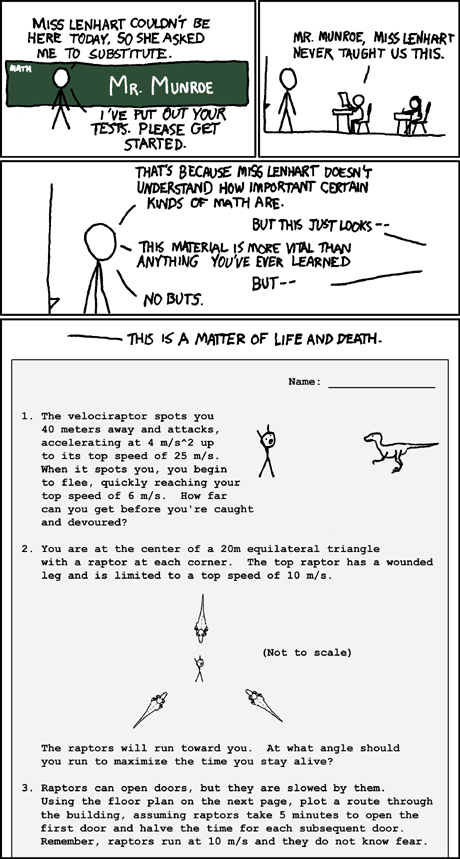
I’ve been thoroughly enjoying a wonderful webcomic - xkcd

One I found recently that gave me cause to chuckle was this:


Homework, the bane of many a student's life.  There's something about the above comic that I find hugely appealing.  I probably would have failed the questions, and been thusly consumed by Velociraptors - but it's homework I would have loved receiving.

As a teacher I’m not a huge fan of giving out homework (this is an understatement) - to be honest I’d rather kids go home and spend the same amount of time playing games with their parents.  It’s one of those things though - many families expect and want their children to have homework - so despite several years of assiduously avoiding it as best I could I’ve decided to try and slightly different tack to traditional maths and spelling questions.  Every week the kids in my room delete from and add questions to a matrix - questions relate to various topics - mathematics, literacy, the Arts, science and our theme (which this term is ‘Australia’).

I’ve been pleasantly surprised by both the questions asked and the answers found.  We have had some really complex questions posed - such as ‘Why don’t we fall off the Earth?”, “How was Uluru formed?” and “What is the oldest type of writing?” As well as a range of questions that reach from the inscrutable to the relevant and philosophical. They also cover a satisfying range of topics - not simply mathematics and spelling (though both of those as well)!

I’ve tried to ensure that questions are a mix - some simple; requiring a little research, some more complex.  Some asking for pure opinion, some for creative thinking.


example of our homework

Ultimately I don’t expect my grade 3 and 4 students to walk away remembering that the gravitational force generated by our planet’s mass is what attracts us to the surface, or that Uluru was formed by millions of years of sediment build up, or that cuneiform is a form of clay-tablet writing used by the Sumerians.  

What I do want though is for students to find out little bits and pieces about things they didn’t know before hand, to have some stake and say in what they research or respond to, to think and read about things outside their normal spheres of experience - things they may never look at in school again.  The very act of thinking and asking the questions we put in the matrices is giving them a valuable voice - something they may not have had much experience of before.  

Hopefully they walk away with an increased sense of curiosity, with the idea that they can ask questions, and can go looking for the answers.  And perhaps most importantly: that learning is not just about being able to spell correctly or find the correct answer to an algorithm (as important as those things are).


So far we all seem to be enjoying it - as much, at least, as homework can be enjoyed.  I’d still rather they play games with their parents, but for the time being at least this is interesting - and the responses I've read have been the range of fascinating, well researched, carefully thought out and creative. We shall see how it lasts...


If you have any questions for the class - tweet them to @Pritchard_class with the #homework34P


Sunday, 25 March 2012

Gaming from the Classroom

As a part of my role as one of the literacy leaders at school (my place of work during daylight hours), I gave a short presentation last week on various short and sharp literacy activities one could use in the classroom.  I focussed on the use of technology - the interactive whiteboard and netbooks - as well as on a small group of literacy related games.

Technology is one group of tools I really enjoy using in class, I believe it allows for a huge amount of flexibility, and diverse ways of gathering and sharing information.  I also am a strong advocate for students having choices in what they do and how they do it - so having access to resources that allows for this is fundamental to how I like my class to operate.  You can find some more of my thoughts on why technology is a great tool for the classroom here.

Games are also something I value as tools in the classroom - sure they can be linked to key curriculum areas like literacy and numeracy, they can even be used very specifically for this purpose, but one aspect that is very important is the fact they are a socially engaging activity.  Students look at, talk to, and interact with each other when playing games - and this aspect is, for me, the strongest reason supporting why they important and useful in a class or school environment.

At the Literacy Professional Development I talked about four games, some of which I have mentioned before - Backseat Drawing Junior, Bananagrams, My Word, and Upwords.

Here is a quick run-down on why I think these games have a place in the classroom:

Backseat Drawing Junior


In Backseat Drawing Junior one player has a picture card displaying a simple picture (say a house or a flower), this player must give directions to another player - who, following those directions, must draw what is being described.  Of course the director cannot simply state ‘draw a flower’ - they instead must give specific instructions - like, ‘draw a small circle in the middle of the board, draw a line from the bottom of the circle that goes down toward to the bottom of the board.’ etc.

This forces the players to be specific in the kind of language they are using to direct.  Not only are they using language such as: left, right, up, down, across, circle, square, and so on, but they are doing so in an attempt to achieve a very specific result.  Their success can be seen.  It is also vital, of course, for the illustrator to listen carefully and follow the instructions they are being provided.

All in all Backseat Drawing Junior is a very good game at getting students to communicate with each other in a very specific way.  It is fantastic for communication and oral language skills, but is also very good at getting the players to think about the words they are using and how they are using them.  This is one of those games I’d have in every classroom I teach in - not only is it great for encouraging all these fantastic skills, it is a game that the students love playing.

Bananagrams


Another game I have already blogged about in this context.  Bananagrams has players using letter tiles to build a crossword style collection of words.  This is a tried and true spelling game.  I like bananagrams because it forces the players to match the letters they have in front of them with their knowledge bank of words.  Because they can use letters already placed (like a crossword), it also forces some creativity in how the words are placed together.  While I used Bananagrams as my example, it could also as easily have been any number of other spelling games like scrabble or boggle.

My Word


My Word is again one of those games that every classroom should have.  It is simply a deck of cards with letters on them - cards also have many digraphs like ‘sh’, ‘th’, and the like.  Players flip one card over at a time, when a player sees or can make a word from the cards face up they say it and take those cards as points.

I like My Word - it’s a simple game, almost just an activity, but I have used it as a spelling game with the entire class, a small group game, and I’ve also used it with individual kids.  My Word is a really useful resource - something that many activities can be performed using.  It is particularly good with students who struggle with spelling - cards can be moved around, placed together in words, single cards can be changed out to make new words and so on.  As a game I would absolutely state that there are better ones out there, as a resources for the classroom I find it highly useful and very good.

Upwords


Upwords is basically scrabble, with the added novelty of being able to place letters over the top of existing letters to make new words.  For a spelling game this novelty makes for a fun addition.  As a game for the classroom I think this adds a huge amount of value.  Knowledge and familiarity with spelling patterns is important, games like Upwords, which encourage the changing of one word into others, quickly and easily demonstrates how many words use the same spelling patterns.  Changing a vowel here, or the onset or rime in a word is manipulating the language we use and clearly showing off how some words relate to others that sound the similar.

Upwords has the additional advantage of being easier than games like Scrabble - because you can simply add a letter to a word already on the board there are many more opportunities open to you.  This means that students with a diverse range of spelling abilities can play this game - as opposed to something like scrabble or bananagrams, which are much easier for those with a solid ability to spell, and a large vocabulary.


So those are the games I discussed, and some of the reasons I think they make for great additions to the classroom.  I know I’ve blogged about some of them before, but let’s be honest - when it comes to games - there is no such thing as too much.

We have our school games day coming up this week - so my class will be busy learning games ready to teach.  I’ll blog about that later in the week.  Until then...

Cheers,

Giles.

Friday, 23 March 2012

Spiders and Dinosaurs


The Castle has been a bustle of activity recently.  Jupiter is bright in the sky, the winds have been howling and bitter for the time of year, the sun has been out, then clouded over, then out, and heavier than normal rains have caused flooding in some nearby towns - luckily the only ill effect this has had on us has been the need to cut the lawns more than usual.

There was a spider incident earlier this week – a particularly clever, powerful and wily one managed to circumvent our defences and make it’s way indoors - my wife - after the fashion of all great dictators - simply declared she wanted it ‘taken care of’, as if it was a troublesome witness in a multi-billion dollar drugs case.  She stipulated only that I wasn’t to make a mess.

Understand this: there are two ways I wage war against spiders and their kind - chemical, or violent. Sometimes both.  

Avoiding a mess was a troublesome consideration my methods were ill-equipped to accommodate.  On the plus side, if I could manage the deed when no-one was around then I could clean up and pretend that little out of the ordinary had happened before the UN inspection team arrived to ensure nothing unsanctioned was going on.

Perhaps I should have captured it, taken it outside and released it.  But then maybe it had grown to like the indoors - no chilling wind, no rain, no hawks, no other spiders to battle with over territory and webbing rights.  Then I stared into it’s beady eyes; for a moment I imagined I could see into it’s fractured mind... yes, the indoors are nice... all I need to do is to rid the place of the large mammals inhabiting it... yes…

Needless to say I was shocked and alarmed at these imagined confessions and dark hopes.  Immediate and decisive action was required to neutralise the threat.  I did what had to be done.  Bilbo would have been proud: progeny of Ungoliant defeated in a mighty, but short, struggle.


Work has been hectic, for some reason the ends of a term never wind down like the romantic image of a clockwork toy slowly losing power.  They end violently, like a supernova, a splash of frenetic energy and then gone. 

I presented at a Professional Development this week – on a variety of Literacy Tasks.  Happily I managed to squeeze in some games like Bananagrams, Backseat Drawing, My Word and the like.  I’ll blog about it in the next few days – I feel it went well, but one never knows of course – unless there is an immediate and spontaneous cry to build a colossal statue commemorating your achievements.

I also ordered a new book.  I’ve been looking at a bunch, some on the dark ages, some the crusades, some about the Normans in Italy and Sicily, Alain de Botton’s ‘Religion for Atheists’ – which looks interesting.  In the end I ran with something out of left field.  ‘Dinosaur Odyssey’ by Dr. Scott Sampson – the same Dr. Scott from the Dinosaur Train animated series.  


It looks good – I loved dinosaurs as a youngling; when summer’s passed glacially over the Castle like a haze of warmth and sunshine, when grasses seemed greener and lizards scurried to and fro in secret hurry.  Now my lad is falling in love with dinosaurs like I did, and that is helping me rediscover my fascination with them as well.  Dinosaur Odyssey covers a lot of recent palaeontology as well as a more general overview of their mighty epoch – which should make for interesting reading.  I’ll try and do a review once it has arrived and I have read it.


So a week has nearly gone again.  The turn of the universe passes silent and implacable, only the death of a spider and the bustle of work to mark its movement here at the Castle.  Hopefully I’ll manage to blog again in the next few days – I’ll give a quick description of the games I related to literacy, and our school games day is coming up as well – so I can’t miss talking about that.

Until then.


Cheers,
Giles.


Monday, 12 March 2012

War of the Ring


I should enjoy nothing more right now than the telling of a long tale by the fire side at the Green Dragon, Bywater.  I’m afraid, however, my newly planted legumes cannot abide my long departure, so a shorter version shall have to suffice.

I played War of the Ring last night.  So long had it been since I last dusted off the rules and laid out the game that this really felt like I was learning it all over again.  This later turned out to be a good and a bad thing.  Good because my opponent, the erstwhile Matt, had never played before, and bad, because I realised again the glorious and rolling tale this game encompasses - and was saddened therefore that it hadn’t seen a lot of table time between!

The game took a lot longer than it should have - being new-again to the rules was as much a help as a hindrance, I knew roughly what should happen - but finding the particular rules was like trying to find a hobbit that doesn’t want to be found.

War of the Ring, for those unfamiliar with it, is an epic game that attempts to recreate the the unfolding tale of political and military machinations that are the backdrop to the wonderful Lord of the Rings trilogy, by J.R.R. Tolkien.  The Shadow player is attempting to mobilise his armies into the right places in order to affect a sweeping and overwhelming campaign against the Free Peoples.

The Free Peoples on the other hand are a disparate and disunited group of nations, apathetic and unknowing to the wave that will soon be breaking against them.  The Free Peoples player must activate and motivate to action the various nations in order to hold out against the forces of Sauron long enough to allow to the Fellowship to make the trek to the Cracks of Doom.

War of the Ring is a game that really rewards replaying.   There are many nuances in what can and does take place, and many choices to make about what and when to do things.  I won’t describe the rules in minute detail, nor cover our game.  Suffice to say it was highly enjoyable and thematic, and it left me wanting to play again; the game moves forward like forward like a cohesive and epic tale - as it should.

Lord of the Rings is my favourite book.  War of the Ring is possibly the best game adaptation of that theme that I have played.  It is a magnificent effort: to condense the tone and scope of the books into a game experience the way has been achieved in this one.  A wonderful game.

Now I want to play it again!


Cheers,
Giles.