Tuesday, 29 October 2013

A Magnificent Day...

About an hour after waking Fleet Commodore James Harrison (Harry to his men, Jimmy to his old school mates at the race track) was feeling magnificent.  There really was no other word for it, he had gone to bed dreading the worst of what a night of whiskey and cards might bring come morning, but come morning he felt glorious.  The night before the cards had fallen his way and he now had a pocket full of bank notes.  To add to the jubilation he had received a telegram, freshly wired, informing him the horse he’d backed in Melbourne had come through by a full length the day before.  Today was a magnificent day, there was no doubting it.


Happier and more sprightly than a man who had helped knock off a bottle of Grouse should have any right be, Harry took his time over breakfast, and took it in good stride even when a second wire arrived informing him the joint fleet of Covenant and Free Australian ships he was leading had finally caught wind of the Russians they had been chasing.  Weeks at sea chasing rumour and wreckage had yielded nought, but Harry had had a feeling and taken a gamble; trying to step ahead of his enemy rather than following their wake.  The gamble had paid out, and now the rumours and mist they’d been chasing had turned into ships and men they had found. today was a magnificent day...

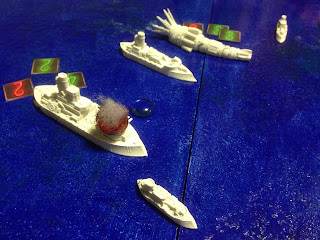
Harry, lucky to head the Russians off in all the open sea, lines his ships up.  A mixed force representing a joint operation between the Free Australians and the Covenant of Antarctica.

The Russians, keeping their knock-out punch solidly in the middle...


Taking water and whatever fresh supplies they could from a small island chain in the vastness of the Indian ocean the Russians had a right to feel unlucky to have been caught by the fleet so far following only the rumour of their wake.


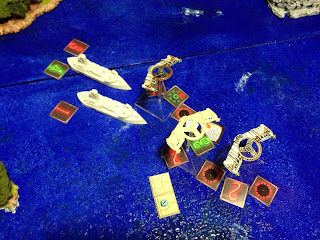
A mix of the frigates and Victoria Class gunships concentrate their fire on the opposing fleet commodore and the squadron of cruisers making up the right of the Russian strong centre.  Some lucky strikes manage to shatter the ablative armour of their opponents.


With the plan hinging on a boarding action against the Russian commodore, a submerged Aronax heads directly.  It's advance is preempted by heavy fire from the Bounty, the Victoria gunships and the Protector Frigates - all of whom, with some luck and daring, manage to inflict some early damage.


The Protectors roll in, and with some incredible luck both their gunnery and broadsides manage to break the ablative armour of the Cruisers ahead of them, and shred half a squadron of heavy frigates to their left.


While the barrage of fire from the frigates, the gunships and Harry's own Bounty manage to wreak merry hell on the Russian fleet a squadron of dive bombers swoop in and light the afternoon with some spectacular fireworks.
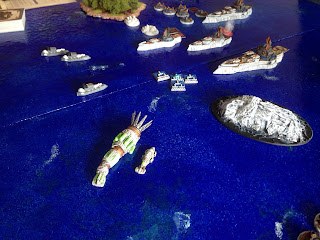

Surfacing in order to shred the escorts and pile more damage on the Russian flag ship the Aronax proves it's fearsome mettle...


Under the burning sun and after a lucky guess, the pride of the Russians was withering under a storm of hellfire... Harry couldn't stop from smiling, today was a magnificent day.


_______________________________

And we called it not long afterwards, James and Ewen (joint Covenant/Australian and the Russian commanders respectively) had to leave, and the battle was heavily skewed in favour of the Covenant and Australian forces.  The range of heavy damage from the Bounty and the Victoria class gunships had managed to crack the usually frightening armour of the Russian ships early, and some insanely lucky rolling meant that anytime the dice were thrown, the Russians would suffer.

This game really moved at a fast clip, and 1000 points made for a nice and interesting fleet, some heavy hitters, some mediums, and some smalls.  A great game and a lot of fun (well, I was joint commander of the Aussie/Covenant Fleet - so things went my way).

Can't wait to play again!

Cheers,
Giles.


Tuesday, 22 October 2013

If Not for Patagonia...

Koleny, Admiral of the Covenant of Antractican Expeditionary force, unsealed the brown envelope he had removed from the drawer in his desk.  He read slowly and deliberately, paused, knocked back a dram of Cognac, and re-read.

The world at large was a spinning mass of cogs and wheels, with the dizzying array of changing, merging and shifting alliances, partnerships, deals and betrayals all too turbulent and messy for Koleny.  He no longer bothered to try and keep ahead of who was in bed with who, it all seemed a macabre and crazy dance, best to just put your head down and soldier on.

In a twisted way he admired the powers that were easiest to peg-hole - the East India Company for example were and probably always would be unscrupulous bastards.  The Australians owed their loyalty at the lowest level to the British (at least the Royal Australians did), then next the highest bidder (being formidable mercenaries), and finally, most importantly, to each other, despite their internal division.  It was easy to keep track of that way, kind of neat and tidy in an otherwise messy world.

Koleny sighed, glancing back at his orders again, he liked Australia; as part of an ongoing agreement between Free Australia and the Covenant Koleny had spent years in Sydney training future commanders of the Free Australian Navy and he had come to think of the Country as something of a second home.  Still, Royal Australia wasn't really Free Australia, orders were orders, and the machinery of international diplomacy was a shambles he wasn't planning on expending too much thought on.  He would have to be careful of course, his was a small force and the Australian's were famous for having both big guns and a positive love for boarding actions.

He glanced around his gas-lit cabin as he poured himself another dram, well, if it was a brawl they wanted, it would be a brawl they'd get.  The Covenant weren't known for their ability to board or even resist boarding, but this technological terror was another story, time to put this Aronax class submersible to the test.
______


Off the coast of South America a small Covenant force seeks out and finds a mercenary fleet of Royal Australians operating in the area.


Neither the Aronax nor the Time Dilation Orb have been tried by Koleny in the heat of battle.  


First casualty of the engagement, the big guns of both a Victoria class gunship and the Cerebus flagship lay waste to some Covenant Frigates.


The incomprehensible generators of the Time Dilation Orb teleport the Aronax into the thick of battle.  The biggest Australian ships have already activated, and the Aronax powers up its cloud generator and weapon systems.


After a blast from the maw gun and Particle Accelerator both the Cerebus and Victoria to the rear take damage.


First the injured Cerebus, followed by the Victoria, swing about and broadside the Aronax, which takes enough damage to render it's weapon systems useless.


With little hope of getting the weapon systems back online after a lucky hit, Koleny orders the stokers on the Aronax to have at it, and the submersible steams in a wide circle back around the ram the Victoria in the hope of crippling her.


A boarding assault!  Men from the Aronax attempt to prize the Victoria, in the end both ships lose their compliment of Marines, the Aronax is left effectively indefensible, but the Victoria lies drifting and derelict.

Later that turn the weak Aronax, with an injured and brave Koleny, cleaning the taste of blood from his mouth with a flask of Cognac, falls to a boarding assault initiated by a Protector class Frigate.  He had given his all, and in the end, the biggest of the Covenant ships fell to the smallest Australian one.


Soldiering on despite the loss of their admiral, the squadron of Platos swings about and circles the badly injured Cerebus like wolves about a dying calf.


After several devastating broadsides the Cerebus slowly breaks apart and sinks.


The turrets of the Platos, with nothing large left to target, seek a quick end by firing on the wounded Frigate.  A massive 16 hits leaves little in the way of debris to wash up on the shores of the nearby islands.

It had been a struggle, but in the end the Covenant had handily won, despite the loss of their Admiral and his remarkable squid submarine.

_________________

Note:

We noticed after the battle, that we had accidentally left off the table one of the Victoria class Gun Ships that Aussies would have had - how I can't say, but it was entirely my fault.  At the end of the game, while the Covenant had thoroughly won, there had been a tipping point in the mid game, where the Aronax had it's moment of glory, and it was in this tipping point that the game could have swung.

We'll say that the other Victoria was hauled to in a natural port along the coast of Patagonia, trying to make contact with their SUSA employees, but we'll never know how it could have been...


Since playing I've also managed to finish a few more models...


Now to start work on my Aussies...

Cheers,
Giles.


Thursday, 26 September 2013

An Epic Game...

For a little while I’ve been thinking about writing a series of reviews, each based on a single word, like epic, majestic, lucky... some form of adjective, like a word association review - which game matches that word to my mind and why.

To kick what will probably be a sporadic enterprise off, and in keeping with episode 323 of The Dice Tower, a podcast about board and card games that I am a sometimes contributor to, this review will be based on the word ‘epic’...
__________________


An epic game...

I could write about burgeoning space empires exploring and exploiting their way to domination, or fantasy slug fests where armies of untold steely eyed warriors do battle for dominion.  But instead I want to focus on the historical, the type of game that charts the growth, development and ascendancy of empires and civilisation.  No theme could so fully engulf the term epic as this.

There are many of course, some great and long lasting like the empires they simulate, there are others that are less so, they burst forth in a maelstrom of forum post laden excitement and fade into the footnotes of game history.

The game I want to talk about seeks to compass a scope and span of human history that no other game I know of dares to assault.  It is Origins: How we Became Human, by the inestimable Phil Eklund.  Now, I need to begin by stating the typical Eklund Caveat - this game is obtuse, unbalanced and complicated, and is certainly not for everyone, not even for most perhaps.


However, for those fascinated by the theme, Origins: How We Became Human is a civilisation game like no other.

Is it epic? Well four letters do little to expound on it.  It is a game of evolution, beginning some 120,000 years ago it tells multiple tales as players guide their civilisations through this enormous gulf of time.  In the first age players represent a variety of hominds, from Neanderthal to Cro-Magnon man, to Homo Floresiensis and Homo Sapien.  The goal is the achievement of consciousness, and players develop social and technological practices that will help them spread, develop and unlock aspects of their developing selves, literally unlocking parts of their brains, and access to behaviors that may have been beyond them at an earlier stage.


In the second age the variety of hominds have disappeared and players represent cultural groups struggling to reach modern consciousness through the invention of metaphoric language - a Jaynesian and controversial perspective.

In the third age players struggle with ideologies, and seek to build and develop the most advanced and complete civilisation before the game winds to a close.


It is a game that seeks to explore not only the rise of civilisation, but the rise of us ourselves, it compasses not only the development of technologies, but explores the impact those technologies had on our potentials, it’s a controversial perspective on the evolution of modern human consciousness, and in every game, every player walks away with a story to tell.  


This is not simple civilisation building, where the drive and output of generations of a people is anatomised and boiled away to a short race to build the biggest building.    Origins How we Became Human, by Phil Eklund, is not an epic civilisation building game, it is a game the charts history as we know it.  This is a game that seeks to explore, through play, the journey of our species from our humble beginnings to the scintillating glories of our modern achievements, in short, this game tells the story of us.


___________________

If you have any suggestions, words or phrases that would be fun to base reviews around for this series - feel free to add a comment and suggestion!

Cheers,
Giles.


Can't see the Forest for the...

A little while ago now I set out to make some forested pieces of terrain for my growing terrain collection - mainly for use with Song of Blades and Heroes (although I also have Dux Britanniarum that I'm itching to get to the table).

I wanted something modular, and something easy to store.  In the end I settled on a simple system using cheap round drinks coasters.

I chose coasters because they were cheap, because I could sit them next to one another with ease, and because without the trees they could also be used for rough terrain, or similar.

On each coaster I traced out some circles where the trees would go, painted the remainder with PVA and liberally coated them with sand I nicked from my son's sand-pit.


After shaking off the loose sand and undercoating them:


I used a dark brown paint, followed by several lighter layers of dry-brushing - each of course lighter than the last, with the final layer being a very thin coat of a flesh tone.


Lastly I added some static grass to break up the monotony.  They aren't highly detailed bases, but with the trees on board they look perfectly table-suitable.


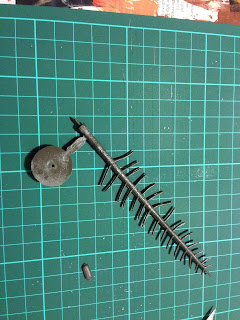
The trees themselves were a part of a Woodland Scenics pine trees kit.  There were a mountain load of trees in there, so I have plenty.  The trees themselves were relatively easy to put together: cut away the bases (which I also glued to metal washers to make them a little more likely to stay upright), glue them, twist the trunks to splay the branches out in different directions, and finally add the clump foliage.


Woodland Scenics recommends using their Hob-e-Tac glue - which worked perfectly well, although seem to never dry fully (rather the point I think).  I liberally sprayed the foliage afterwards with watered down PVA to help them stay together.

All done they are not majestic and amazing scenic dioramas, but they look reasonable, were cheap and quick to make, look good on the table, and can be used to make lots of little copses or a couple of larger forests - I'm happy.


Being used in a game of Song of Blades and Heroes:

Different shaped coasters in use...


Cheers,
Giles.


Tuesday, 24 September 2013

Risk Legacy and a New Legacy Game in the Offing...

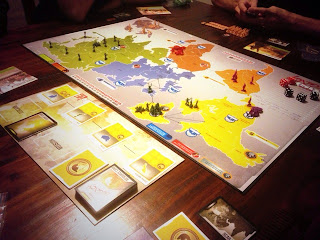
Risk Legacy broke on the gaming world with some turbulence.  A new take on the traditional game: one in which the game would evolve and change with each game, and one where those changes were permanent.  The prospect of writing on the board, adding stickers that couldn't be removed and tearing up cards was enough to send a shiver down the spine of some.  Seen as a gimmick to drive sales by a few at the time, to me it seemed a gimmick which held the promise of actually being a fascinating game experience.  Sure the game may be permanently altered and never reset to be replayed, but I have to be honest, if I manage to play a game 15 or so times then I have well and truly got my money in terms of play time - there are a great many games in my collection for which I paid more and have played far less, but I digress.


What is it about Risk Legacy that fascinates me?  The prospect of the game growing as it is played is certainly one part of that.  But there is more: the ability to name things, make choices about what gets a sticker and what doesn't, what may get a bonus and what doesn't - lasting impacts that a player can leave on a game.  The game grows certainly, but not simply in the sense that more and more rules and pieces are added as secret packets are opened.  The game grows as a result of the player choices, players indelibly stamp their experiences on the game board, it becomes a shared history... and this I think is an exciting and fun concept.


I'm really enjoying Risk Legacy, and I'm lucky enough to be playing in a group where the players, like the Led Zeppelin song, stay the same.  It is better this way, as the names of cities, continents and the placement of stickers are historical markers that spark some recollection of a game, event or experience in the shared history of this game we are moulding together. In-jokes and references abound, and are added in messy layers to the game board - a developing pastiche of our experience with the game from its opening to today.


Thinking about the system a little, the idea of growing a game and altering forever its make-up, I was struck by how well suited the idea might fit with an epic fantasy game - where secret packets opened to reveal the machinations and plot development of the arch enemy.

Well Rob Daviau, of course, is well ahead; just recently announcing SeaFall - a game that will be published by his own company (IronWall Games) and Plaid Hat games.  A 4X sea borne empires game with a similar evolutionary bent - a game where players explore, claim and name islands, where grudges between empires have the chance to blossom over many games, where empires can evolve and develop over the shared history of the game as it changes through the ages of play.

Image from the Plaid Hat website.

Colour me excited!

The Plaid Hat podcast has an episode where Rob discusses his game - well worth checking out!

Cheers,
Giles.


Monday, 23 September 2013

Fortune and Calamity...

Orders from the Admiralty were clear, but far from straightforward: protect the small British expeditionary force resupplying and repairing off Padang, Sumatra.

The Royal Australian navy was called into service, a fleet dispatched to Sulawesi was never intended to engage, but rather draw the attention of any of the Empire of the Blazing Sun who might be watching the region from their bases in Papua.

Another fleet was dispatched to patrol the waters south of Sumatra, as the prying eyes of the Covenant of Antarctica were a ceaseless and an ever-present threat.  

As this second force took in water off Christmas island word from the Natives sparked and stirred excitement; green lit ghosts had been witnessed far out to sea, flicking and whipping in the great distance only the night before. The Sea was angry, it was said.


Setting out to run the fleet parallel with Sumatra the Admiral plotted a course to the Cocos Islands... it would be around a small chain of islands off the main archipelago where the Royal Australian Fleet would run afoul of the Southernmost empire; the Covenant of Antarctica.


It seemed on first blush that from the size of both forces it would be a chess like skirmish, but such idle thoughts would bely the truth of what would eventuate.  The Australian admirals gave orders that the Covenant flag ship be taken at all costs, we had to know, they said, what the Covenant did...

The Australian fleet, arriving spread out over such a distance was too disparate to allow for a concentrated effort, and in a stroke of poor luck the flagship of the Covenant was tucked well away from the Tasmania class Sub Tenders and their lethal cargo of Crocodile Attack subs, the Australians best chance of achieving their goal.


Hoping to cause enough damage to cripple, but not destroy the Aristotle (the Covenant flagship), the two Victoria class Gunships move to a more flexible position.  Whether the Aristotle continued in its path or feigned and made a turn, they should be able to heave-to and have her in their sights.  Coupled with the might of the Cerberus pocket Battleship they should be able to inflict enough damage to weaken her for boarding.  The only fly in the ointment was the fact that the attack subs had been deployed well away from the prospective conflict.


Focussing their attention on the gunships several torpedo barrages from the fast moving Diogenes frigates managed to inflict some damage.


The battle around the Victoria Gunships became a turning point, with the Covenants Ptolemy bombers, the Diogenes frigates and a wave of dive bombers all wreaking havoc.


Damage was heavy both sides, but the use of mines made this damage more widespread than focussed, which left both Victoria class gunships seriously damaged.


While the middle and right of the battle was give and take, the Tasmania class sub tenders came under fire from a squadron of Plato cruisers, a lucky hit on the ammunition supplies sent one to the sea floor while the shrapnel and concussive force of its demise left the other Tasmania crippled.

In the end the Australia fleet took a beating.  While able to land enough fire on the Aristotle to basically cripple it, they were seriously impacted by a spread out deployment and apt use of flanking attacks from faster vessels.  While a solid fight, the Australians limped away the battered party... taking only small solace in the fact that a lucky hit toward the end managed to sink the Aristotle... sink without capturing was a lesser success, but far better that than no damage at all!

__________________

This was a very fun battle to play out.  600 points a side, two players on each side... a lot of fun.  The magazine explosion and the sinking of the Aristotle were highlights, but the use of mines against the Victoria class gunships was also highly successful.

Devastating ordnance is exactly what it says on the shell casing: devastating!  In one barrage the Aussies managed a whopping 23 hits on the Aristotle... not dice, but hits.  And it was moments like that and the explosion of the Tasmania that make the game memorable and fun - the outrageous swings of fortune, of fortune and calamity.

Good fun!

Cheers,
Giles.


Wednesday, 18 September 2013

The Event...

Annually my school runs a Games Day.  I wrote a couple of weeks ago about the various game related programs we run, and that we were gearing up for our games day.  I'm very happy to declare that The Event has come and more sadly that it has passed.

Rock the Beat.


As exhausting and demanding as our Games Day can be it is also a wonderful experience.  Over the course of the day we have some 400 or so kids come through the hall - all engaged in the act of playing games.  The kids range in age from 4 to 12-13, and we also had young adult refugees from the Shepparton English Language Centre come across to join in.  A huge range of ages, needs, prior experiences and abilities.

Niagara.


Facilitating the day is a cadre of students we call the Games Ambassadors - mostly from my class of grade 3-4 students (ages roughly 7-9), they have the unenviable job of teaching and managing the games at the tables.  My personal feeling is that such a mentoring opportunity is great for leadership, empathy and a range of other skills - and wow was I impressed.  The Games Ambassadors rose to the challenge, managing to teach games to players with such a massive range of abilities is a daunting task for the average 7-9 year old, but what a job they did.

Kids of Carcassonne.


Some of the players had no English skills, many couldn't count, or spell, and yet all were engaged magnificently - a real tribute to the Ambassadors, a shining example of what anyone can achieve.  I was really taken with the way the Ambassadors slipped naturally into the role of mentors and teachers, these kids, on the fly and with prompting from me, were modifying game rules and in some cases making up wholly new games to suit the kids at their table (as well of course as teaching the games as they were meant to be played).

The Amazing Labyrinth.


Seeing older kids explaining patiently a game to a group of fidgety 4 year olds, seeing younger kids explain a game to a group of 18-25 year olds with very limited English, seeing everyone engaged and playing, laughing and having fun was surely one of the standout highlights of my year so far.  I cannot speak highly enough, or be more proud of my class and the other kids who volunteered to take on the role of Games Ambassadors.

Double Shutter.

I can't wait till our next Games Day!

CooCoo the Clown.


Jungle Speed.

Cheers,
Giles.