Friday, 16 November 2012

A day in the sun...


We spent the morning class in the garden planting seeds.  A fantastic morning.  Let me stop there and explain a little.  It’s been awhile since last I blogged about some of the happenings at my school.  This term our theme is science, a topic I much enjoy teaching, and that covers far too many areas for the time we allot to it.

One of the things we are doing as a part of our theme, aside from the more general joys of making light bulbs shine, balloons pop and volcanoes bubble, is planting vegetables, fruit and herbs in the school’s kitchen garden.

This pleasant little hide-away seems a world away from the typically poorly lit and stuffy classroom (and don’t get me wrong – I love my stuffy classroom).  It’s a small garden, with room for several large garden beds, many more smaller ones, fruit trees, a work shed, a chicken pen (currently on the lookout for tenants) and a nice bit of lawn.  It had spent a little while overgrown, but with the advent of our science theme, myself and the teachers in the middle section of the school were intent on getting our students out of the rooms and into the garden.

On the face of it this may not seem an academic pursuit, if your concept of education or the purpose of school is all about spelling patterns, phonographic knowledge, syntax, place value and renaming numbers you may well ask what the point of such a diversion is.  For me, the point is rather simple: it’s real.

That’s not to say that verb conjugation or decimal/fraction equivalencies aren’t real, or to slight or malign the importance of such things in the general scheme of education.  But there is a visceral, tactile, physical, and invigorating reality to burying your hands in soil to plant a seed, or watching a plant grow that you have tended that is immediate and apparent: it is directly experienced, not a thought experiment or conceptual framework.

Burying your hands in the garden is an experience that can be used as a basis for writing, or maths, or drawing or science, or any other subject for that matter.  It’s an experience that speaks to the kids about the nature of nature, about the science that describes the beautiful machinery of this world in which we live.  It’s an experience you can lay your hands on, you can succeed at and fail at and watch the results play out as a consequence.  It’s an experience that pours information to the brain through all our senses, the sights, smells, sensations and sounds.

I find gardens and such places cathartic, that’s not to say I’m an avid gardener; I avoid weeding wherever possible and can kill the hardiest of plants with seemingly little effort.  But I find the experience of nature, well, nature that isn’t trying to eat me, pleasant and refreshing.  Sitting in the warm shade while the leaves twitch in the breeze, suddenly starting, and then easing to calm as the breeze dies away, where insects crawl, fly, buzz, drone and wander about going on with their business oblivious of us idly observing, is a great environment for learning.

Yesterday we watched the moon occlude the disk of the sun, today we caught a gecko, and planted pumpkins and beans, basil and lettuce.  These are the moments I love as a teacher.


A poor photo of the eclipse - taken on my phone through protective glasses.

Monday, 12 November 2012

Cupboards, cups, and entropy...

The cupboards in our kitchen seem to be unduly influenced by the laws of thermodynamics. At least, insofar as my little golden book of thermodynamics level of understanding is concerned.


As the arrow of time has progressed the neat order that once represented our methods of storing cups and pans and whatnot has been slowly replaced with a system dominated by chaos.  Additionally, the owning of children has seemed to have sped up this process.

Stage one, ‘Order’: In this low entropy state, the state of highest structure and order, our cups and pans were grouped in sets, occasionally by colour or size, a favourite perhaps jostling for front position, but otherwise neat.  Some of the shelf they rest on is even visible.  This stage does not last long.

Stage two, ‘The descent’: Energy is added to the system in the form of that mug set given as a birthday/moving out/engagement gift. An ill-conceived Tupperware party brings new vessels into the house demanding storage. A cup or two from this set and that is dropped and broken.  Individually these additions and subtractions can be roughly accommodated into the system without completely destroying it, but the accumulation of new cups/pans/utensils/whatever has the net effect of increasing the entropy of the system, order is giving way to chaos.

Stage three, ‘Disorder’: Eventually the cupboards reach a point where cups and mugs are piled higgledy piggledy; they become a veritable teetering wave of crockery.  We stack the front ranks carefully, as a bulwark against the tide behind, but beyond that porcelain structure pure chaos rules.  This is the high entropy state, the laws of thermodynamics have taken hold and carried what was a very structured system into the realms of disorder.  Any further and a cupboard door opened too swiftly could precipitate a wave of ceramics that would take man, child and beast along with it.  The only upside of such a tidal wave would be finding that cup I used to love for tea and haven’t seen in years.

There seems little I can do to reverse the process, this is simply my story.  It could happen to you, you have been warned...


Cheers,
Giles.


Pirates of the Spanish Main

Many moons ago, in the early days, when my board gaming was but a dalliance between roleplaying and table top games like DBA and Warhammer I found much to like in, what was then, a new and exciting game - Pirates of the Spanish Main.


This was a collectible/constructible card game, where the pirate ships were pieces stamped out of plastic cards (like credit cards) that one popped out and clipped together to make a little 3D ship.  The game was enjoyable, but also wildly unbalanced, and being of a collectible nature the imbalances in the ship powers, particularly as the number of different sets grew, forced players to continue buying more to stay in the ‘arms’ race.  I left it long ago for greener pastures, but kept my various ships and bits in a box in my classroom in case any kids wanted to play with them.

Since my days of playing this game passed by, the various plastic ships have been carted from school to school, from class-to-class.  Many have broken or fallen to pieces, and I didn’t lose much sleep over the matter.

In the last few weeks there have been a group of kids in my class that have shown a real interest in these ships, and not just playing with the ships, but playing the game.  Last week I worked my way through my box of Pirates of the Spanish Main, finding and putting back together the ships, matching them with ship cards and so on in an effort to build a basic set that can be boxed together and be played - and what’s more, provide a roughly balanced experience.


In the end I managed to salvage some 20 ships or so, and with various islands, treasure tokens, crew tokens and so on, they now sit apart, ready to be played.  We’ve had a couple of games so far, and the kids seem to really enjoy it.  The basic game: find treasures and sink your opponents, is simple, and because of it’s simplicity a lot of fun.  It’s still not the most balanced game in our school games collection, but it’s one that is enjoyable, easy to pick up and play, and exciting!

Seeing those pirate ships hauling-to across the table-top again after so many years of neglect and dry-docks is somewhat pleasing.  Hoist the Jolly Roger and chase down the treasure, and whether it be the crash of grape-shot through the mizzen or the clatter of dice on the table - the spirit of the Spanish Main is alive again.


And apparently there is a new card game due out soon based on the Pirates of the Spanish Main property, published by WizKids and designed by Bryan Kinsella and the Australian game designer Phil Harding... I shall have to investigate further...


Cheers,
Giles.


Tuesday, 30 October 2012

The Games in Schools and Libraries Podcast


Games in Schools and Libraries is a podcast by Donald Dennis and myself that covers all things to do with board games, card games and digital games, and the place they can find in schools or at the local library.  We’ve been busily recording episodes and posting them over at the Games for Educators website, but we’ve also had a fair share of technical glitches and difficulties that none of us (at Games in Schools and Libraries or Games for Educators) expected.

There were RSS problems, authentication issues, a lost episode (if you happen to spot an episode on the history of computer and digital games let us know!) and so on.  All in all it meant that our intended release schedule was interrupted, and that listeners were bound to have trouble finding us on iTunes, and subscribing via their favourite podcatcher (I use Downcast on my phone, and love it).

So this post is here to make the bold statement that these technical issues are done and over.  Our RSS seems to be working perfectly, and our podcast has (finally) been authenticated by iTunes - so you should be able to find it there in the next day or so.  Much thanks to Pat over at G4Ed for working solidly on the issue and getting it solved!

Episode 8 has just been posted, and all seems well with the world.

So here are some quick links and information on the state of our show so far:

Our RSS can be found here.
Our page on Games for Educators can be found here.
Our guild on BGG can be found here.
Our website (bare bones at the moment) can be found here.

If you punch our RSS address into your podcatcher of choice, you should be able to see our episode list, this is what we’ve covered so far...


Episode 0 - Welcome and Introduction - Don and I introduce ourselves personally and professionally, and talk about what we hope GSL will grow in to.

Episode 1 - Board Games - A short discussion on the modern era of board games.

Episode 2 - Digital games - The lost episode, we shall not speak of it...

Episode 3 - What Makes a Good Game - In which we consider some of the aspects of games that make them solid choices for schools or libraries, including durability, easy set-up and play etc.

Episode 4 - Considering Rules- In which we talk about how the rules of a game can make a game more or less suitable for a school or library environment - as well as some of the things we look for in games.

Episode 5 - Game Spaces - In which we discuss making a space ready for playing games, as well as some of the physical considerations worth taking note of (at least in our experiences).

Episode 6 - Themes - Part 1 - Can themes help make a game easier to digest? We talk about themes that tie into curriculum or topics, and how games can be used as a window to a subject.

Episode 7 - Themes - Part 2 - What themes aren't suitable for a school/library setting.  What are some of the things worth considering when getting a game for such a setting.

Episode 8 - Accessibility - In which we discuss physical accessibility issues, from games with kids to physical disability to colour blindness, games that have a high reliance on written text or even where card/board text is too small.


So that is Games in Schools and Libraries so far, we hope that people find it a useful and interesting podcast, and occasionally entertaining as well.  We have a collection of other topics already recorded, and a list of those we have yet to record.  If you have any comments or feedback - we’d love to hear it! Comment here, in the guild on BGG or over at G4Ed - or drop us an email (schoolsandlibraries@gmail.com).

Cheers,

Giles.


Monday, 29 October 2012

Cult of the Old...


Episode 92 of On Board Games aired recently, and I was lucky enough to fill the third chair for the roundtable discussion.  In the episode we discussed the cult of the old - older games that retain their polish and allure despite the intervening years and the number of newer, more shiny offerings available.  One of the interesting discussion points was on what actually constitutes an ‘older’ or ‘classic’ game - how old does a game have to be to hold the vaunted position of not having been replaced by something newer.


In the board game consumer market of today the pace of new releases seems to be increasing at a massive rate.  Games released now need to be marketed, or capture the imaginations of the community, sufficiently to gather the attention required to clamber high enough to be seen.  Ten years ago it was absolutely within the realms of possibility to know what games one would see from an event like the Spiel or GenCon, but now it seems, to me at least, that a vast number of individual titles disappear in the haze of releases.  The signal to noise ratio is drowning out a great many titles.

Fairy Tale - my go to filler even after several hundred games...


Perhaps this is a subjective experience, perhaps I am taking less note of the titles, designers, publishers, kickstarters and so forth that appear each day.  Perhaps the consumer market is large enough to support this explosion of releases, with games now less often becoming the popular title, and more often appealing to niches within the broader community.

The old edition of Condotierre - a wonderful game...


Whichever way you anatomise it, I think it is apparent that the market is booming.  Is there room for all this growth? Perhaps, but that is a discussion for another time.  What does all this mean for the On Board Games topic? What then, in an industry where a game can hit its most popular before it is released and be almost forgotten by the time the boxes are shipped, makes for a game that is ‘old’?

Starfarers of Catan - my favourite of the Catan variations, best enjoyed with Daft Punk playing in the background.


For the sake of the On Board Games round table we did our best to provide some temporal yardsticks: 10 years, even 5 years. In truth I think the answer is highly subjective.  Of course some of the games I have loved are new to me but old in terms of publication date.  Some games are hot from the minute word gets out of the Gathering, or from the Spiel or BGG.con, but then fade into obscurity almost immediately.

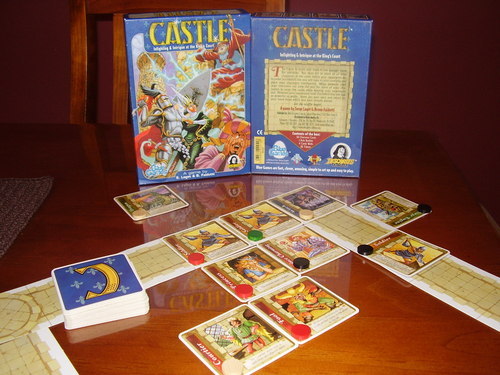
Castle - Still one of my all time favourite card games, thematic, zany and a whole lot of fun.


I think ultimately the answer, for me at least, must be in the length of time I’ve owned and known them for.  A great older game for me is one that has been in my collection for years, in some cases from the start, and are nonetheless sitting front and center on my shelves.  These are the old favourites, the games I’ve played many times and yet haven’t wearied in my eyes.  These are the games with boxes worn by continued removal from the shelf; that have sat in the collection for a long time, and are yet still some of the least dusty.  

For me these games have stood the test of time, they have sat next to new boxes on the shelves and remained when the new have been put somewhere dusty and less accessible.  The rules stay unreferenced, the pieces familiar and known.  When it hits the table we all, in idle chatter, set up our familiar stacks or decks or patterns of bits, rather than reading through to see who gets how many of which one was it again.  These are the classics, and every game shelf, every cupboard, every gamer's old gems are idiosyncratically different.  So what is the cult of the old? It is, in a word: subjective.

Cheers,
Giles.


Friday, 26 October 2012

Star Wars: X-Wing


Today I managed to play a couple of quick games of Fantasy Flight Games Star Wars: X-Wing.  I realise that getting too involved in discussing Star Wars is likely to tarnish my reputation as being quite geeky, but a quick glance over the last few posts here on the Castle, where I discuss painting miniature anthropomorphic warriors, should demonstrate that I am currently on an upward trend (geekiness wise).

From www.fantasyflightgames.com

Star Wars: X-Wing is a miniatures game of sorts, it is a game for two players (more with more sets) where each will take the roles of the Rebel and Imperial forces from the later (or earlier) Star Wars movies (later or earlier depending on whether you rather the chronologically by release date or setting).  Of course movies IV, V and VI are the ‘real’ Star Wars as far as I am concerned, episodes I, II and III are all toy commercials that I will hurl invectives at till I weary of the joy of it (not anytime soon).

But back to the game - it is really all rather simple, players run through phases of planning, movement, combat and end of turn clean up. Unlike many FFG games this one is clean and simple.  There are no teetering piles of hundreds of cards nor mountains of special tokens.  Planning is simultaneous, with each player selecting the move they want to make on a special dial.  This is neat and simple, allowing different ships access to different moves, and also keeps all the players doing things rather than waiting for others to finish.

All the ships from the core-set - very nice miniatures

Movement is also simple - each move is represented by a different length card board token, place this in front of the ship, pick up the ship and move it to the end of the token, and movement is done.  Of course, the fun of trying to visualise where exactly any given movement piece will land you, especially when the play area is congested with asteroids and other ships, can be a challenge for the visual-thinking impaired among us, but it is a lot of fun.

Set-up and ready to play, you can see the movement tokens on the right.

Combat doesn’t add any significant complexity to the game, if a ship is in range you may shoot it, with both players rolling dice to see what will happen.

Of course there are also a bunch of additional rules that can be added as the players learn the game or desire more complexity.  With everything mixed in together this remains a straightforward and highly enjoyable game.  The focus of the game is obviously on maneuvering your ship into a position where it can shoot without being shot.  It’s a game that doesn’t take long, is enjoyable, and also light enough to break out and play without having to pour over the rules book in order to remind yourself of the minutia involved with playing.

The dog-fight is on!

There are two negatives as far as I can see them, firstly the box is one of the worst ever created for the purpose of housing a game - like a net bag for carrying spaghetti. And second, it is quite possible that if you fancy collecting all the bits and pieces released and to-be-released by FFG, this will become a very expensive game.  Oh - and I suppose another negative is that there should be a special rule whereby any TIE Fighter that contacts an asteroid immediately explodes in a fireball of carnage.

One TIE Fighter is about to go BOOM...

Wings of War - a similar and earlier game.

There are obvious comparisons to be made between this game and Wings of War (published now by Ares Games).  They are indeed similar, and X-Wing could easily be seen as an evolution of Wings of War.  Personally I find the games different enough to enjoy both, they are indeed as different as say Fairy Tale and 7 Wonders - both games where playing drafted cards is a core mechanism.  I also think the movement system in X-Wing is better, if by the simple physicality of the pieces (Wings of War uses cards rather than thicker cardboard tokens, the latter allow, in my opinion, for a little more flexibility as well as being actually easier to use).  My favourite of the two games is clearly X-Wing, not only does it have a theme I enjoy more, but the game has both a simpler mode of play (great for my classroom) and a more thematic and complex version (great for home) than does Wings of War.

All in all I think Star Wars X-Wing is a neat game - I’m not sure if I’ll be rushing out to buy extra ships and more core sets, but it’s certainly a game I’ll relish getting to the table again.    A solid and fun game.

The last note is a simple word of advice: It would be best if you avoid playing with people who like to make the sound of TIE Fighters as they move their ships - this can start to wear at ones sanity after about turn 1.

Despite my best TIE impersonations - MWWWWOOOOOOOOOOOOOOOOOOMMMMMMMMM - this was the final moment for my last TIE Fighter this evening. My wife flew back to base a heroine, and the rebels counted another victory (Rebel Scum!)

Wednesday, 10 October 2012

Looking to the horizon...

My current painting project is not quite half-way done, there are still squirrels, shrews, foxes, weasels and a wolverine from Splintered Light miniatures to paint, and yet I am already looking to the horizon, looking to what my next project will be.

My finished miniatures so far...

This is the trouble with miniatures gaming, something avoided in the board gaming hobby by the simple fact that everything one requires for a game can be found within the box.  With most miniatures games you get a set of rules you like the look of, and are then left with the job of finding the pieces you'll play the game with.  Of course, this is also a fantastic thing about miniatures gaming, you can also find some wonderful miniatures and then locate or modify rules to accomodate them, the flexibility and personalisation of a game is hugely enjoyable.

So, my conundrum: I have the rules I want to collect minis for, now the job of finding the minis I want to use with them.  The game is the most excellent looking Dux Britanniarum, by the Too Fat Lardies, a set of dark age miniatures rules that has an in-built campaign system that reads like it will be a lot of fun.  The question now is what figures do I get to play the game with?  The Too Fat Lardies sell sets of 28mm miniatures from Gripping Beast, but I really feel like I want to run with a smaller scale, for all of the reasons that it takes less time to paint them, they take up less space when stored and of course, they are cheaper.  This leaves me with an interesting couple of choices I have been see-sawing over the last week or so.  I think I've finally come to a conclusion, but for the sake of this blog post I'll run through the two choices that have been gnawing at my inner-most, miniatures related, thoughts:

The choice over scale comes to two options, either 15mm or 10mm.  I love the look of the 6mm Baccus Miniatures, but I don't think they'd really suit the Dux Britanniarum look (at least the look I want).

Of those choices I've singled out an option for both, Splintered Light sell sets for Dux Britanniarum, containing everything required for one army in one set.  Now, I'm currently painting some Splintered Light minis, so I can easily vouch for their quality.

Splintered Light Saxons...

The advantages here are multiple:

  • They are available in sets that supply exactly what you need to start.
  • They are good quality.
  • They can also be used to serve double duty in Song of Blades and Heroes if the mood takes me.

The other option was to run with a 10mm, and I liked the look of the figures from Magister Militum.

One of the Saxon figures from Magister Militum...


The advantages of 10mm are also multiple:

  • They are cheap for a large quantity (I'd not need to buy more)
  • The look reasonable quality
  • They 'should' be quicker to paint
  • They could serve multiple duties (Dux Britanniarum, Dux Bellorum, Song of Arthur and Merlin)

There are of course downsides to both as well, 15mm are more expensive per figure, and I'd need more figures than the base sets sold by Splintered Light require.  10mm are, obviously, very small!


At the moment I am really swinging on the 10mm end.  The reasons are quite simply that I think I could get them painted quicker, they would be easier to store, I'd get as much as I need in short order (more in fact), and I can use them for multiple rules sets.

As much as I think the Splintered Light figures I have are wonderful, and as much as I like the look of the sculpts for their Dark Age range, I really like the idea of having a bunch of 10mm figures for use.  Sure they'll be small, but their size and the quantity I'll get will mean I can use them for Dux Bellorum as well, without the need to bolster the numbers by additional purchases.  I also think I'll be able to paint them more quickly - ha! We shall see.  So for now, 10mm are the victors in this stouch, we shall see how I feel when the time comes to place an order!

The various rules I'm hoping I'll be able to play at some point:


Some links:


Cheers,
Giles.